
‘…For men must work, and women must weep,
Though storms be sudden, and waters deep,
And the harbour bar be moaning.’
. ~ Charles Kingsley (Three Fishers)
Phase 4: The Salt Path: Westward Ho! to Bude
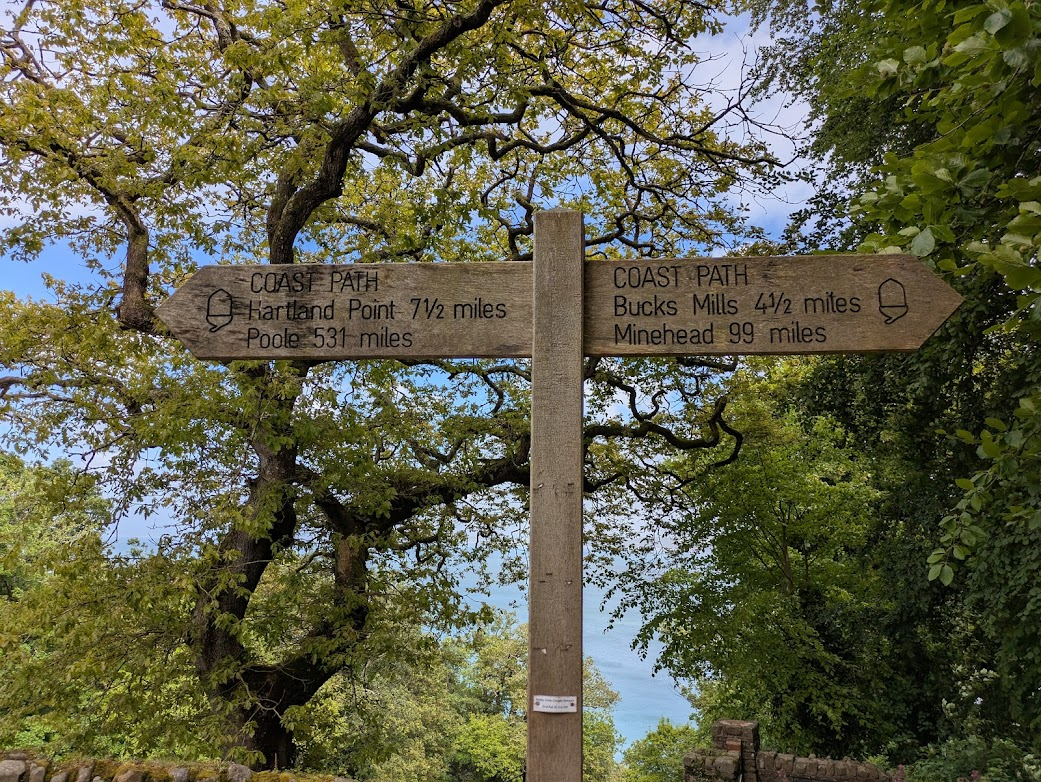
Our accommodation these past few days has been a lovely, comfortable, compact barn conversion that sits right on the border between Devon and Cornwall and covered us for the stretch of the Salt Path from Westward Ho! in Devon – the only town in Britain with an exclamation mark in its name – to Boscastle in Cornwall. Along the way there has been a plethora of remote, picturesque fishing villages, complete with doll-sized stone cottages and steep, narrow streets, completely unsuitable for any vehicle but a donkey.
One such village was the childhood home of historian, novelist, and poet Charles Kingsley, who, you may remember, wrote The Water Babies. He was also responsible for a poem, ‘The Three Fishers’, about the harsh realities of a fisherman’s life, their families constantly alert to the life-threatening dangers of working on the sea. The poem was published in 1851. It was later set to music by English composer John Hullah and became a popular ballad. (Coincidentally, Australian writer Henry Handel Richardson used the line ‘And women must weep’ as a title for one of her short stories written in 1931.)
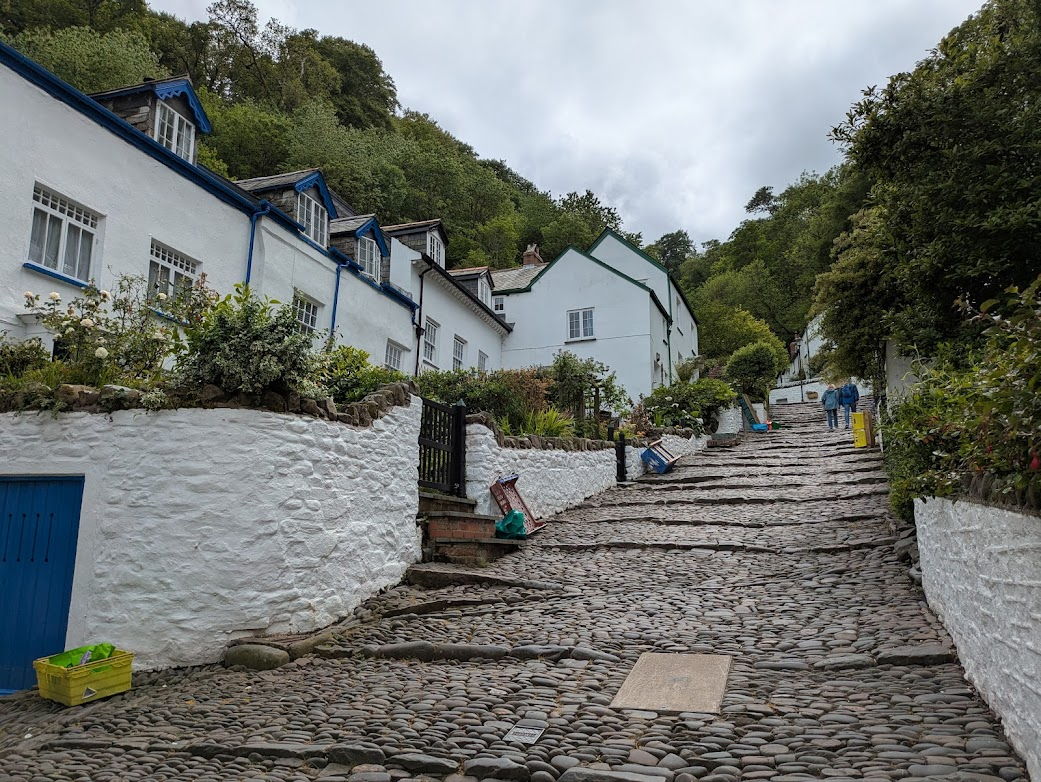
Clovelly is an age-old fishing village that has somehow evolved down the centre of a dramatic ravine in the cliff face, on the rugged north coast of Devon, overlooking Bideford Bay. Consisting of eighty-three cottages, Clovelly is privately owned, with no cars, no stairs, no lift, not even a zip line for easier access. Visitors – and residents – must park their cars at the top of the cliff, and make their way down the precipitous, cobbled high street on foot. Preferably not in heels! In the past, donkeys were used for transport. Now they are enjoying their retirement, and residents must use sleds to pull everything up and down the hill, from furniture to food, luggage to garbage. Even the local milkman uses a sled apparently!
How fit must you be to live here?
Originally, the land at the top of the cliff was farmed by the Celts, who built an Iron Age fort on a plateau, known as Clovelly Dykes. Located just a mile inland from Clovelly village, it is one of the largest hill forts in Devon. So how many are there to compare? Apparently fifty!
After 1066, the Clovelly estate was owned by William the Conqueror, who gifted it to his wife, Matilda, and had it entered in the Doomsday Book, that first giant survey of England and Wales completed on the orders of King William. In 1242, it was acquired by the Giffard family, also Normans. (I wonder about that word acquired. It could cover a multitude of sins. Was it bought, stolen, gifted..?
Within a hundred years it had changed hands again, and been purchased by the Cary family, who was responsible for building the drystone breakwater at the base of the cliff, to replace a rudimentary, 13th century quay and thus create a solid, safe harbour for the local fishermen.
Due to its perilous cliffs and treacherous seas, this stretch of coastline once earned the nickname “The Shipwreck Coast.” While these shipwrecks were sometimes caused by bad weather – or poor navigating – the area was also infamous for ‘wreckers’. These local smuggling gangs deliberately lured ships onto the rocks in order to pillage and plunder their cargo. (Try reading Daphne Du Maurier’s book Jamaica Inn for the grisly details.) And when the fog hangs low over the cliffs and the wind whips across the sea, it’s not hard to imagine a world of brutal pirates, cunning smugglers and grinding poverty, and the likes of Joss Merlyn growling ‘dead men tell no tales.’
Christine Hamlyn inherited the estate in 1884. When she married in 1889, she and her husband went to work renovating the cottages. She also asked him to change his name, as hers had such a long connection with Clovelly, and there were no male heirs.
John Rous, the current owner of Clovelly, is Christine’s great grand-nephew, and has continued her work there, ensuring that the village is not taken over by holiday makers, but remains a real community; the cottages are leased only to full-time residents who live and work in the neighbourhood. It is, however, the tourists who keep the village intact: the entrance fee charged to visitors helps to maintain the buildings and ensures Clovelly retains its unique charm and timelessness.
Unfortunately, we did not stay long – the One & Only had just finished a gruelling day’s walk and was ready for a hot shower – but we paused at the inn for a cider, said a quick hello to the donkeys, and enjoyed a few moments at a lookout above the harbour. My ticket was good for 24 hours, so I popped back in the morning to watch the film about its history and village life. I was going to venture back down to the village or perhaps to the gardens at Clovelly Court, but the mizzle had set in, and I was wary of slipping on the cobblestones and ending up in the sea!
And speaking of cider…
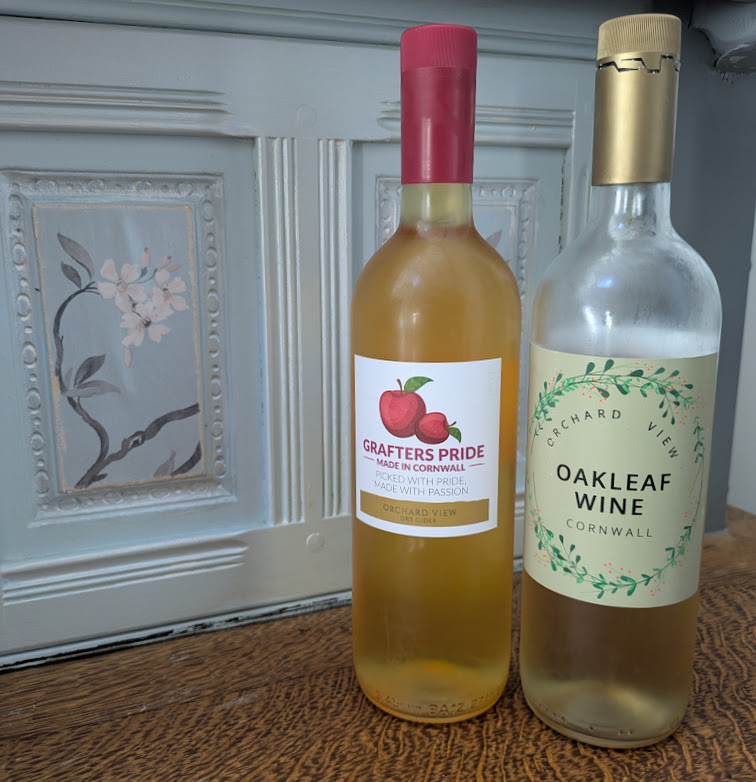
Just in case you have never come across it – however unlikely that sounds – let me introduce you to my favourite local beverage. Cider is an ancient alcoholic libation made from the fermented juice of apples, unlike beer, which is brewed from barley and hops.
As I am not a beer lover, cider was my best (cheapest) option when I first went backpacking around Europe. In South Australia, where wine is King, I don’t often consider drinking cider. But back in the west country this summer, it has become the obvious choice. (FYI: ciders from the Southwest of England are generally higher in alcoholic content.)
Cider can be sweet or dry; cloudy or clear; light gold to dark amber brown; sparkling or still. Most types of apples, including crab apples, can be used to make cider.
Cider has been around for centuries. Apparently, Julius Caesar found the Celts fermenting crab apples right back in 55 BCE. While these days the recipe and the taste for cider have spread all over the world, cider is a quintessentially English beverage, its history deeply rooted in England’s southern counties, Kent and Somerset, and the “Three Counties” of Gloucestershire, Herefordshire, and Worcestershire. Traditional English scrumpy is a rustic robust style, typically cloudy, still, and filled with apple flavour. But I won’t drown you too deeply in the folklore of cider-making. I’ll simply recommend that if you’ve never tasted it, try it. See what you think.
In the meantime, lets go for a stroll to Bude, a more accessible seaside town just south of the border, but still on Bideford Bay, at the mouth of the River Neet. Originally a busy harbour, it became a popular seaside resort in the Victorian era. And there is an amazing tidal pool on Summerleaze Beach to the north of the estuary, which is hugely popular with local bathers.
Much of this coastline is protected by the National Trust, who began a campaign in 1965 ‘to address the rising threat of overdevelopment of the coast’. Since then, the Trust has acquired almost 900 miles of seaboard around Great Britain and Northern Ireland, which recently includes a stretch of cliffs at Tintagel in northern Cornwall and a strip of coastal grassland near Swanage, which we visited earlier this month.
Back in Bude, we arrived at the crack of dawn, as the weatherman was predicting hotter days this week, and the One & Only was keen to start early. Needing a leg stretch, I found a suitable carpark and wandered up and over the first hill with the One & Only, before circling back into town. I had parked the car in the middle of the island formed by the river and the Bude canal.
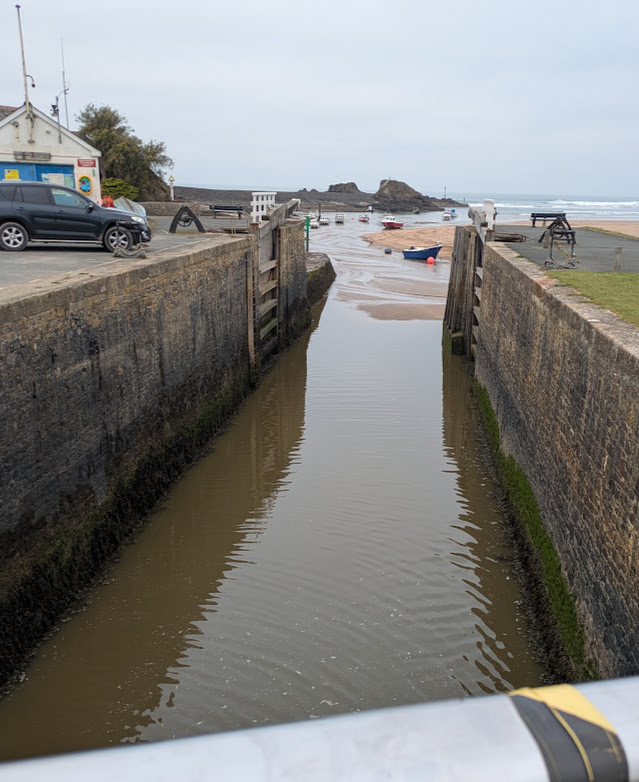
Have you ever seen a canal that ends up in the sea? Of course, it only works when the tide is high, or the boats would through that final lock onto the sand! Apparently, it was built to transport mineral rich sand up to the farms for fertiliser, and rose, through two locks, from sea level to an altitude of 132 metres. I tried to understand a lengthy description of its construction but, not coming from engineering stock, found myself utterly bamboozled. Regardless of how it was made, the results, for mere pedestrians, are lovely. And beside the canal – where I’d parked the car – there was, on this lovely Friday morning, a local market setting up.
The Bude Farmers & Craft market is held on the wharf every Friday from Easter to the beginning of September, from 10am – 3pm. There were all sorts of fresh produce, crafts and clothing available, and I had soon filled the boot with a grainy malt loaf, two quiches, a bottle of local cider and an Oak Leaf wine. Oh, and a sharp and crumbly cheddar. Well, far be it from me to leave such a fabulous block of cheese behind.