
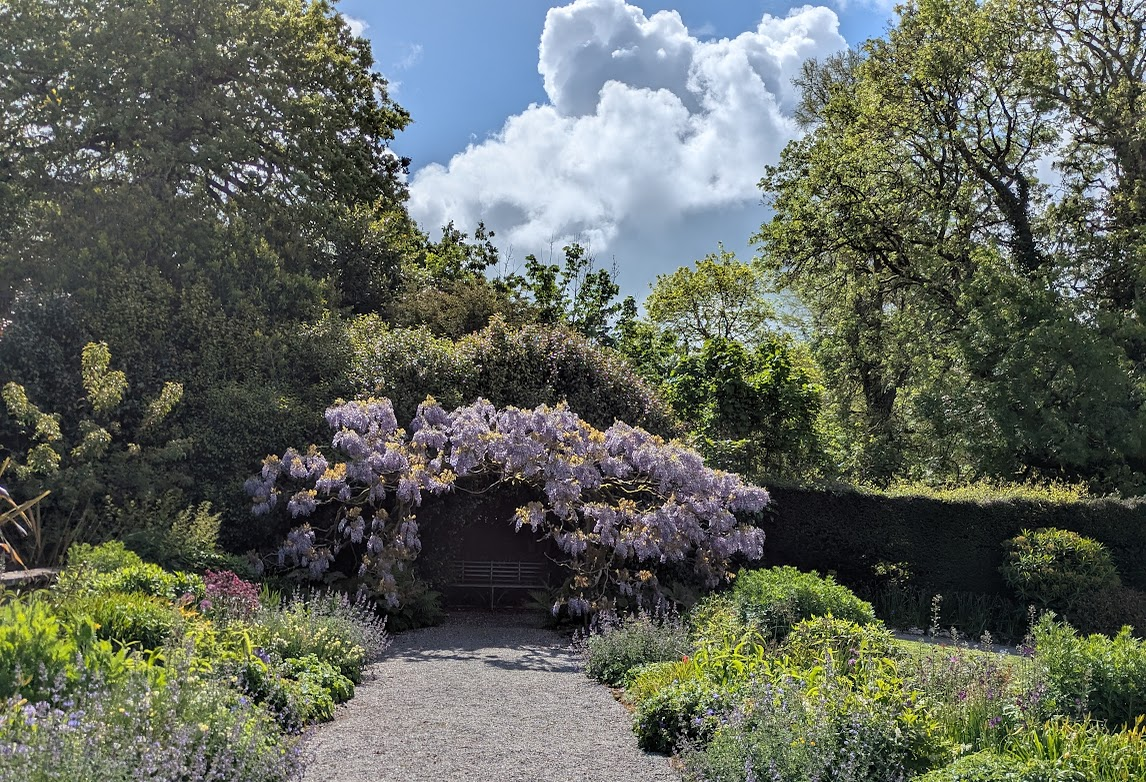
Phase 3 of the Salt Path: Lynmouth to Westward Ho!
Wandering through a tranquil wilderness beneath dappled beechwoods, I emerge into green fields beside a still and silent lake, and it is hard to imagine that I am in the middle of an island of almost 70 million people. There is not a person in sight and not even a murmur of traffic. Only the restful sound of wind in the trees, the soft twittering of birds and an invisible stream down at the bottom of the valley purling and plashing over the rocks. Down on the coast, it was a thoroughly Pooh Bear Blustery day. Here, among the beechwoods, there is only a peaceful serenity as I tread softly along the muddy path. To my left the hillside is submerged in trees, to my right a steep grassy slope is sprinkled with azaleas, gorse bushes and ferns…
Earlier this morning I left the One & Only on the windblown coast neart Combe Martin to hike to Woolacombe, before ducking inland to stretch my legs in the grounds of the Arlington Court estate. Yes, it is indeed another National Trust gem.

As I followed the oak leaf signposts along the constricted, twisting lanes, boxed in by overhanging beech trees and hedgerows, I felt as if I were hurtling down an endless luge track with as much control as the ball in a giant pinball machine, ricocheting past flippers, bumpers, and slingshots. Yet, gradually, as I banked around the curves and accelerated down the infrequent straights, I realized that I was at last rediscovering my long-neglected skills for skimming round hair pin bends and dodging milk trucks and tractors by a whisker. I was Ernie Prang driving the purple Knight Bus, holding my breath as I squeezed through the incy-wincy gaps between those unforgiving stone walls and muscle-bound SUVs. And somehow, I arrived safely at the Leaky Cauldron. Or rather, at Arlington Court.
In the Visitor Centre, I discovered that the house wouldn’t be open to the public for another hour. Never mind, I now had the perfect opportunity to explore the grounds. Arlington Court and its 2,700-acre estate belonged to one family for several centuries, and apparently it is a nine-mile hike around its boundary. Yeah-but-no-but. Today I would only take the two-mile Lake Path, after which I had promised myself a cup of tea at the Old Kitchen Café.
Deep in the woods, doubtless full to the brim with fairies, I nod to the brambles and beech trees, Scots pines and newly minted oaks. I pass by a vivid display of pink campion and a scattering of early bluebells, then a bank of large, glossy yellow kingcups. The unappealingly pungent smell of onion weed catches me unawares, yet it is somehow nostalgic. As I pad along the woodland path, childhood memories of Flower fairy books drift through my mind, and I wonder if there be dragons in the bottom of the valley. Busy blackbirds dart among the ferns ahead of me, before spinning into the shadows. An impertinent grey squirrel scurries across the path and dashes up a nearby tree trunk, before he realizes I am there. Then, like a game of Grandmother’s Footsteps, he freezes, stock still, imagining this makes him invisible. As grey clouds mass overhead, it’s not a good time to remember that I have left my raincoat in the boot of the car, or to notice that my sneakers have sprung a leak.
Emerging at last from the dim and shadowy wood, the landscape opened out towards Exmoor National Park. A green hill like a patchwork quilt, its uneven squares edged with hedgerows and spangled with sheep. Rounding the bend towards the house, I spotted splashes of shocking pink on a tall, skimpily clad azalea. Further on, I reached the back corner of Arlington Court, where a full blown and bosomy azalea was parading a profusion of fuchsia flowers. And beside the azalea, the Old Kitchen tea rooms, where a pot of tea and a slice of orange and poppyseed cake was waiting for me.
***
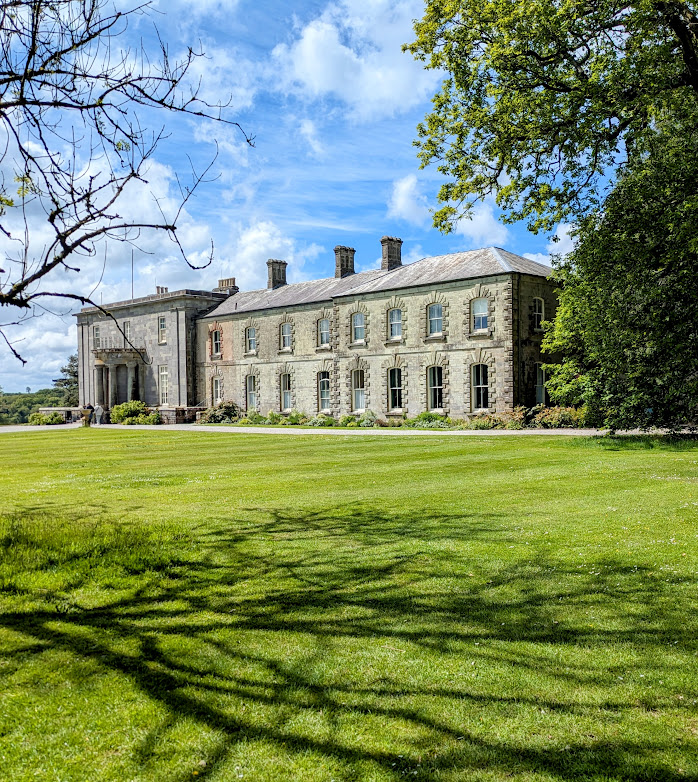
In the beginning, there was a Tudor house-cum-hunting lodge near a mediaeval Church. By the late 18th century, the house needed upgrading, to reflect the more prestigious status of its owner. A fashionable country seat was designed and built beside the original, but within thirty years this shoddy Georgian replacement developed severe structural faults, and the site had to be abandoned. The latest iteration is an unprepossessing, boxy, grey-stone Regency house built some distance from the original. The owner, however, Colonel John Palmer Chichester, died before it was completed. His son, Alexander, added a servants wing; his grandson, Sir Bruce Chichester, added further extensions, to both the house and the stables.
The last owner of Arlington Court was Miss Rosalie Caroline Chichester, the only child of Sir Bruce Chichester, and I have become fascinated with her story. When Rosalie was only sixteen, Sir Bruce, died at the age of thirty-eight, of brucellosis. A pun? Apparently not. Brucellosis is a rare infection you can catch from unpasteurised milk and cheese or from contact with infected animals.
Rosalie inherited the entire estate at twenty-one, along with the vast debt her predecessors had incurred; debt that would take her almost half a century to repay. She never married, but lived all her life at Arlington Court, managing the estate and following her passions for photography, painting, writing and collecting, and turned her home into a private repository. She was also a keen protector of wildlife – to the detriment of the local hunt, who were legally forbidden to hunt across her estate. She also established Arlington as a sanctuary for rare breeds of sheep and Exmoor ponies.
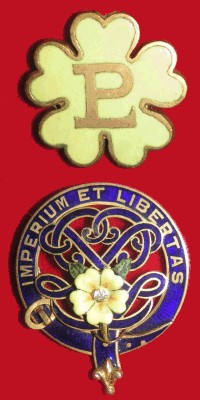
Rosalie was a suffragist, supporting the campaign for women’s right to vote, but she did not approve of the militant methods of the suffragettes. Rosalie and her mother were both prominent members of the Primrose League, an organisation, founded in 1883 to support Conservative, or Tory, Party principles. (Unusually, women were included from the beginning, although eventually a separate Ladies Branch was formed.)
Her story brought to mind Jane Austen’s Emma Woodhouse, who tells her friend Harriet very firmly that she will never be an old maid to be mocked by society for her poverty. As ‘a single woman, of good fortune’ Emma could maintain her independence from both ridicule and marriage, for her wealth would always ensure her respectability. Rosalie Chichester appears to have heeded Miss Austen’s advice, for she chose never to marry, but nonethless maintained a busy, interesting – and presumably respectable – life without resorting to her parents lavish and flamboyant lifestyle.
Born in 1865, Rosalie was educated at home by a governess, and obviously learned enough in the school room to manage the sizeable estate she inherited at twenty one. In contrast to another Austen character, she chose to retrench, prioritizing repayment of debt over personal extravagances. As a child, she had travelled widely with her parents, aboard her father’s yacht, and would do so again, in later life, with her paid companion, Miss Chrissie Peters, but not until the debts were cleared. In the 1920s, however, she travelled to Australia and New Zealand, and took a round the world cruise. The travel bug was obviously a family gene: her nephew, Sir Francis Chichester, was the first man to circumnavigate the world solo.
When she died, in her eighties, her ashes were buried on the bank of the lake at Arlington Court. Adamant that the property would not be turned into a golf course or made into an exclusive club for the elite, she bequeathed her entire estate to the National Trust for everyone to enjoy. Since then, the National Trust have done much to restore the long-neglected grounds to their former splendour.
The house has become something of a museum, reflecting Rosalie’s many interests: collections of pewter and silver; art and textiles; rare seashells and a ridiculous number of model sailing ships (her father had owned two full-sized ones, which presumably added to the vast debt he left behind). Following her example, the National Trust has collected around forty carriages and created a museum in the old stable block. I didn’t make it over to the stables today, as my work was calling. But it’s always good to leave something for next time…
*’A wimpling wind’ comes from the Gerard Manley Hopkins’ poem, “The Windhover”.
**The image of the Primrose League badges came from Henrygb at English Wikipedia. – Transferred from en.wikipedia to Commons., CC BY-SA 3.0, https://commons.wikimedia.org/w/index.php?curid=3970414.