The Final Lap: Falmouth to Bigbury-on-Sea
He made it. Yesterday, after a week on the final run up the east coast of Cornwall and across the border into Devon the job is done. Yesterday afternoon, I joined One & Only on the sand at Bigbury-on-Sea to walk the final few hundred metres to the Avon River crossing, as Burgh Island rose out of the sea mist that has smothered the coast in dense fog for three days.
It has been a trek along more than a thousand kilometres of the English coast – bearing in mind that he had completed the Plymouth to Lyme Regis stretch a year or two earlier. This time, as you may remember, we started in Weymouth so he could walk the Jurassic Coast and fill in the gap from Lyme Regis to Poole Harbour. Since then, it’s been six weeks on the long haul from Minehead in Somerset to Bigbury-on-Sea in South Devon, and last night we celebrated at a very pink gastropub in Yealmpton.
Next on the agenda? Perhaps the new King Charles III England Coast Path of 2,700 miles around the coast of England? Minus the SW Coast loop, of course. Personally, I am hoping for a more sedate stroll along a river or canal, so I can confidently join, without the fear of climbing despairingly steep, hills to reach dramatic cliff tops only to be blown into the Atlantic Ocean or the English Channel. While I am extremely proud of the One & Only’s monumental effort, the challenge of the coastal path has not inspired me. Is that sacrilegious? Or just wimpy? For many, the coastal path seems like a pilgrimage: a purposeful, challenging and hopefully transformational journey, on foot. As I write this, it does start to sound tempting – the opportunity to immerse oneself in these glorious surroundings, spending days in the moment, living, breathing, and observing the world around you, putting one foot in front of the other, day in day out. Still, I think I would prefer a flatter – and less windy – route!
For me, driving through England this summer has been a joy – despite the stresses and strains of which I have frequently grizzled. Yet, those potholed, uncharted lanes like gnarly, knotted knitting, the often calamitous parking arrangements, in the end they just added a touch of spice to days of adventuring among quirky, cobbled fishing villages, wide, tidal beaches, secret coves, buttercup besprinkled cliff tops, thatched pubs and quaint coffee shops, glorious gardens and elegant, ancient manor houses – let’s face it, I’ve actually completed my own version of a pilgrimage without the physical output (although tell that to my shoulder muscles, as I clench the steering wheel to edge past an enormous tractor on a road barely wide enough to overtake a bicycle!)
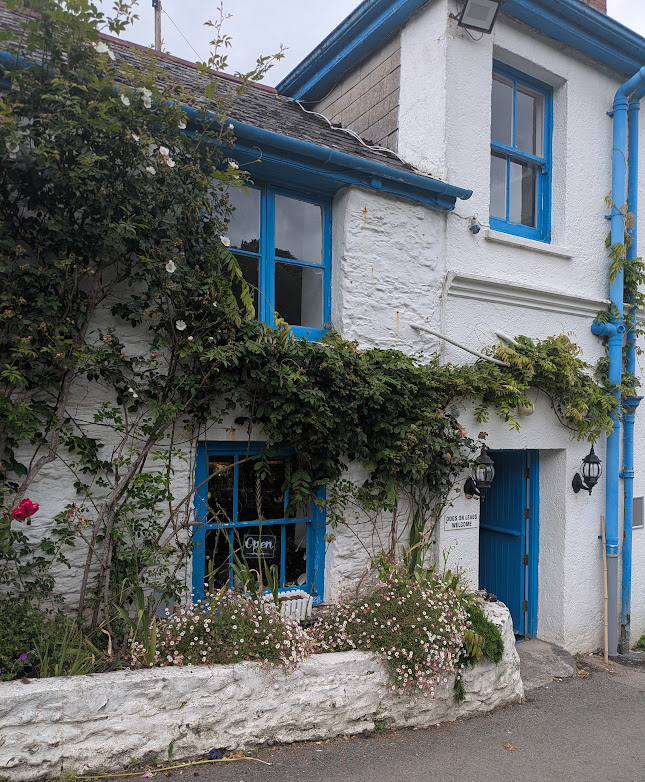
So, highlights on this last section? There have been so many, I may only have time for a selection. (And yes, I have still found time to study.) We have also stayed in some great B&Bs. There was a tiny blue carriage house converted into a one-up-one-down cottage that felt like a treehouse, perched on a terrace above the high street and just large enough for our needs, although not much bigger than a wardrobe. Then, there was a garden flat with an indulgence of elbow-room overlooking a wooded valley and an immensely high viaduct for trains. I have wandered through Truro and Falmouth and Mevagissey and a handful of National Trust properties full of summer flowers and huge bumble bees. And I have had to dodge and weave through hobbit-sized villages which were never designed for cars. This stretch has also been particularly generous with waterways: rivers and streams; estuaries and harbours. And sea mist.
***
Early one morning, while delivering the One & Only to his starting point, I came across a small café, hidden down in a damp and shady hollow in the hills, beside a picturesque and peaceful millpond. And, unlike most coffee shops in Cornwall, it was open before 10am. So, after he had set off, I found my way back to Millensey Mill.
For once, I must extend my thanks to my Google Maps navigator, (long since nicknamed Daphne) who guided me unerringly to the mill, where we found a nice roomy carpark and the best coffee I have had since arriving in England. Generally, I have been holding Daphne entirely responsible for her propensity to entangle us among inconceivably narrow country lanes these past two months. I know she has been thinking that it would be a much prettier journey to head along a perfectly lovely cart track hemmed with foxgloves and pink campion than a dreary old motorway. And that would have been fine, had I been driving a tractor. Or a horse. But all was forgiven as I relaxed in the sun beside a tranquil millpond with my coffee and an extremely tasty ciabatta roll crammed with spicy mushrooms, avocado and rocket. The tables were made of old mill wheels – thick, circular slabs of granite – and I was soon joined by a couple of cheeky robins keen to share my breakfast. Most unexpectedly, I also had an excellent internet connection, so I was able to call the kids in Australia and share the view of Arum lilies reflected in the pond. (And it turns out the Northern Irish barrista learned his trade in Melbourne, hence the excellent coffee!)
***
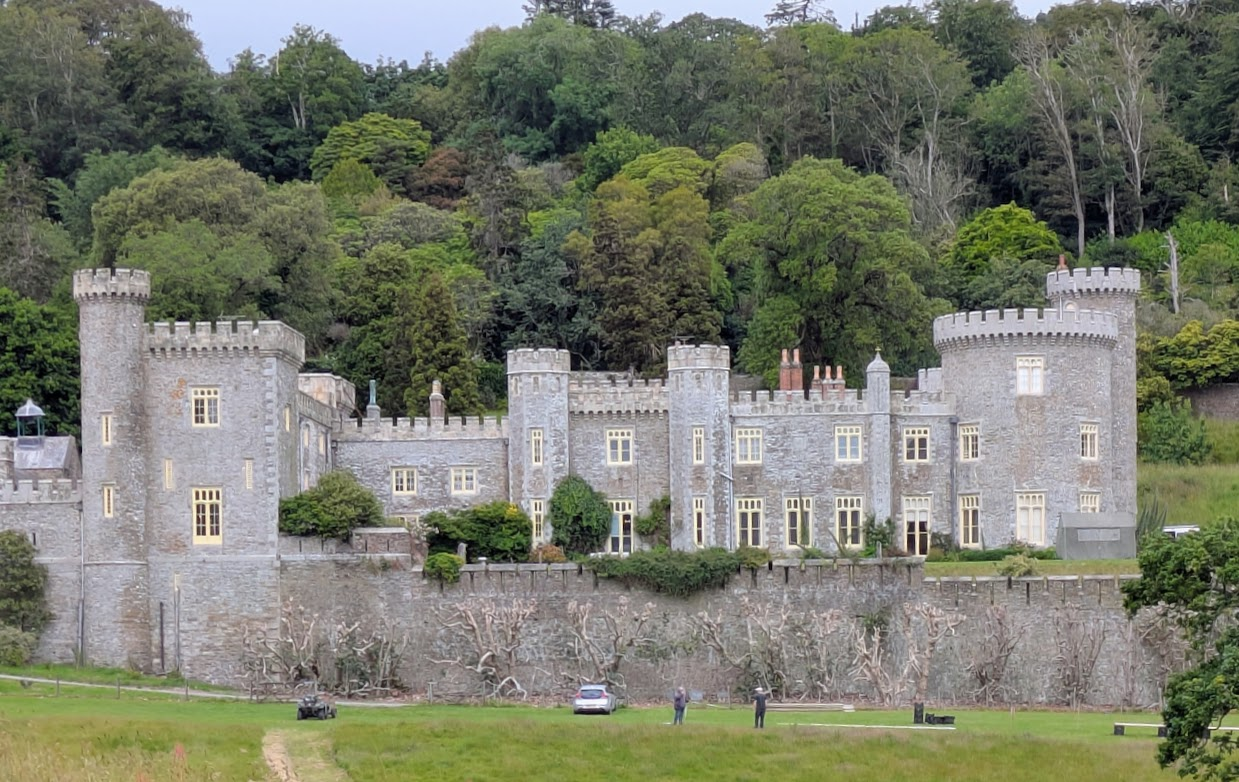
Another morning, I dropped off my keen and dedicated hiker and went a-wandering to Caerhays Castle, a nineteenth century creation nestled into a nook in the hills overlooking Porthluney Cove. Renowned for its impressive collection of magnolias, azaleas, camellias and rhododendrons, it would definitely be better to visit Caerhays in early spring. While I had missed the hillside garden in its full regalia, I still enjoyed a gentle stroll up woodland paths and along grassy trails, which provided the occasional peek of the castle and the sea beyond.
Although the Williams family still lives at Caerhays, they open it to the public each spring, so everyone can enjoy the garden in all its splendour, and get a glimpse of the castle, too if they so desire. It is also popular for weddings and fetes, with its broad terrace facing the sea, it also starred in Tim Burton’s 2106 movie, Miss Peregrine’s Home for Peculiar Children and the 1972 BBC adaptation of Daphne du Maurier’s Rebecca.
The crenelated walls of Caerhays castle make it appear well-fortified against invaders, but it is in fact a glorified folly, designed by the 19th century architect John Nash, who was responsible for Regents Street, Piccadilly Circus, Clarence House, and the Royal Pavilion at Brighton, and for converting Buckingham House into Buckingham Palace.
I joined a tour group of three, and we were escorted through the castle by a very informative and enthusiastic guide named Michael, who also provided excellent tips for neighbourhood restaurants. And low and behold, there was a table inlaid with Australian opal and topped with a rather stubby nosed porcelain kookaburra. Michael was delighted with my discovery.
Afterwards, I dropped into the Magnolia Café for morning tea in the old stable yard, which included a leaky tea pot and a slice of Cornish lamington cake. It was nothing like the original Australian lamington – a cube of light sponge dipped in chocolate and desiccated coconut – but this Cornish variety was infinitely more filling: a dense coconut cake, topped with strawberry jam and sprinkled in more coconut.
***
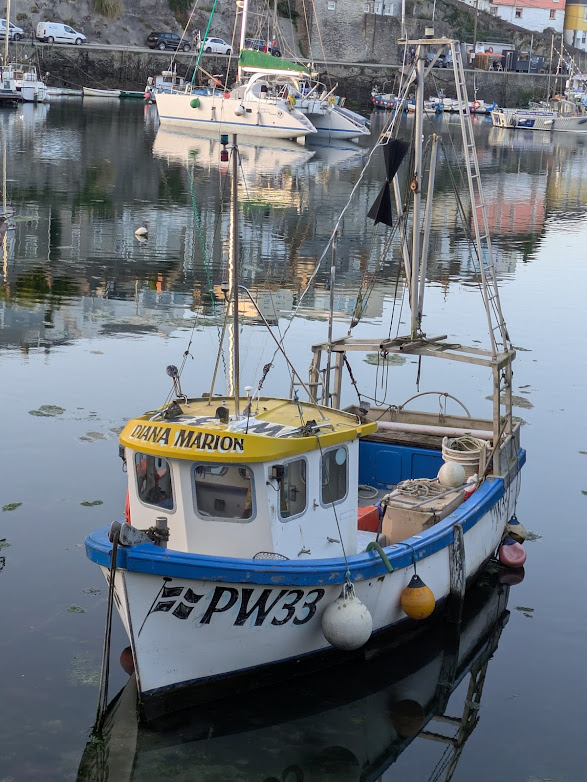
I will finish off with a beautiful dinner at One Polkirt Hill, a restaurant highly recommended by our tour guide at Caerhays Castle. This pocket-sized restaurant serves seafood plucked fresh from the harbour and cooked with a French twist. It is owned by Andre McCowan, once the executive chef at Chelsea Football Club, and his lovely Thai wife Pey, who hosts the dining room and welcomed us like old friends.
We chose a lovely bottle of rose (or maybe two!) and perused the menu. I chose a smoked mackerel pate to start, followed by a Red Thai Curry with prawns, scallops and monkfish, was served with jasmine rice and crunchy prawn crackers. The One & Only went for a beautifully constructed ‘cocktail’ of crabmeat, avocado, and smoked salmon, followed by something from the specials board – monkfish in a brandy and cream sauce. (Of course, there were vegan and red meat choices as well, but it seemed like madness to eat anything but fish when we were sitting only metres from the fishing boats.) It was all, to quote a much-touted TV show, absolutely fabulous.
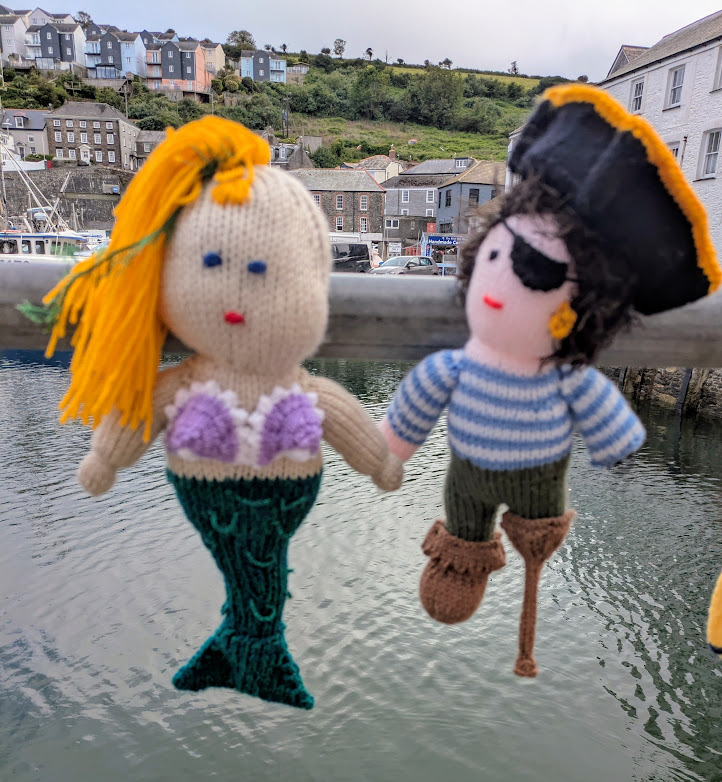
As we were starting on our appetizers, our guide from Caerhays Castle turned up with his wife, and was pleased we had approved his recommendation. Dessert? No chance. No room. But a postprandial walk around the harbour before bed was an effective way to settle overstretched stomachs and clear our wine-soaked heads!
Mevagissey has the sweetest little double harbour, which was built on the site of a medieval quay. Once largely dependent on pilchard fishing, it now houses a mixture of fishing boats and pleasure craft, including a passenger ferry to Fowey (pronounced Foy). The town fans out above the harbour, an abundance of slate roofed houses snuggling into the crook of the hill. Apparently, it’s the second largest fishing-port in Cornwall, and we discovered that the locals love fishing from the harbour walls too. I am definitely going back for a longer stay – and a trip on the ferry to Foy!