For Dignity and Humanity

‘Midwifery services are [vital] to a healthy and safe pregnancy and childbirth. Worldwide, approximately 287 000 women die every year due to pregnancy and childbirth related complications. Most of these largely preventable deaths occur in low-income countries and in poor and rural areas…Many maternal and newborn deaths can be prevented if competent midwives assist women before, during and after childbirth and are able to refer them to emergency obstetric care when severe complications arise.’

~ The World Health Organization

Shiphrah.1According to 2009 United Nations statistics, the Philippines has a Maternal Mortality Rate (MMR) of 230 maternal deaths for every 100,000 live births, which ranks it 48th in the world, well behind its neighbours Thailand, Malaysia and Singapore. The main causes of death include haemorrhaging, high blood pressure and sepsis (blood poisoning), all of which are preventable with proper diagnosis and intervention.

The United Nations Population Fund (UNFPA) is an international development agency that promotes health and equal opportunity for all. It states that professionally trained and empowered community midwives offer the highest quality, most cost-effective access to maternal health care, and play ‘an essential role in achieving the Millennium Development Goals to reduce maternal and newborn mortality.’ Yet midwives are in short supply in most developing countries, and the World Health Organization estimates 350,000 more are  needed urgently in the field.

Dr. Rosalie Paje, division chief of the Family Health Office under the Philippine Department of Health (DOH) claims that ‘midwives play a crucial role in providing maternal healthcare,’ and giving them access to further training in life-saving skills could prevent up to 80% of maternal deaths in the Philippines.

Despite these assessments, the training of midwives is erratic and midwives receive little support, meager incomes, and limited career opportunities. There is also a lack of global standardization of qualifications. And the Millennium Development Goal 5 (MDG 5) seems impossible for the Philippine government, as the country lags far behind the target of reducing the maternal mortality rate to 52 deaths per 100,000 live births.

Despite the odds against them, Jeri Gunderson, her daughter Deborah Gustafson and their Shiphrah.4staff at the Shiphrah Birthing Home attempt to make a difference by helping as many demographically marginalized women through pregnancy and childbirth as possible. The majority of their patients have a daily income of less than US$8 a day, but as Shiphrah is also one of the cheapest birthing home around, it provides a service for the community that almost anyone can afford.

‘Shiphrah Birthing Home is … a public centre where professional midwives help deliver babies of impoverished mothers, providing pre- and postnatal care, and family planning assistance…[and promoting] well-being for pregnant mothers and newborn babies…’

Shiphrah (pronounced Shif-ra) comes from the biblical story of Moses, in which two midwifes defy Herod by preventing the genocide of Hebrew boys. Midwifery is one of the oldest professions for women, recognized not only in the Bible, but also by the Ancient Egyptians, Greek and Romans.

In 1987, Jeri Gunderson arrived in the Philippines with her missionary husband and three young children. The family moved into a five bedroom house in Tikling, where Jeri began practicing midwifery. Before long the whole house had become a cottage hospital for local pregnant women, the family squeezed into one room, as women gave birth in every available space.

Shiphrah.3Seventeen years ago, the nursing home moved into a nearby rental property where it has been operating ever since. Last year, thanks to generous donations, they managed to buy the property and have been making gradual improvements, including a high retaining wall at the rear of the property, for safety and security.

Winding up the steep, concrete road in a rural suburb tucked away at the far end of Ortigas Avenue, we eventually locate the Birthing Home. With roosters crowing in the background, and several small children underfoot, I wander into a large room full of women and girls in all stages of pregnancy, queuing up to be weighed and have their blood pressure taken.

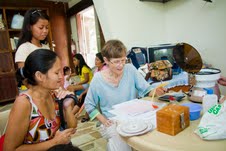
As I sit amongst others patiently waiting their turn, Jeri explains that regular weighing and blood pressure tests should pick up any problems before they become a real issue, while guidance about good eating habits ensure these women maintain their health and strength throughout their pregnancies. She also believes that an experienced and observant midwife can pick up signs of stress or malnutrition with a visual inspection, without the need for invasive internal examinations or expensive ultra-sounds.

Jeri is obviously passionate about the work she has been doing in the Philippines for almost thirty years. Wiry and energetic, she moves from one topic to another – words of wisdom, statistics, introductions – at a speed that makes me wish for a tape recorder rather than my plodding pen.

Shiphrah sees approximately 1,500 pregnant women a year, of whom a third will return for Shiphrah.2the birth of their child, in comforting surroundings and amongst familiar and caring faces. The rest will opt for home birth or hospitalization. Each week staff carry out 150 prenatal examinations and prenatal classes for up to 120 women.

The staff here is loyal and long-serving, and Deborah says she rarely has to interview new staff. Many graduated from the local midwifery college, but thanks to the power of the internet, a number of interns from abroad find their way to the door from as far away as New York. Most plan to come for 2-4 months, but often end up staying longer. Shiphrah also supports the development of traditional Aeta midwives.

As we talk, a young woman is being weighed. Jeri, friendly but firm, explains that the woman’s failure to gain weight is not a good sign. It is Mary’s first pregnancy (not her real name). She is only thirteen. She is treated with the same gentle respect and patience as every other woman in the room.

Deborah takes me on a tour of the facilities and shows me recently redecorated birthing rooms, whose walls – and names – are avocado, mango and tamarind respectively.  She shows me a small wooden birthing stool to illustrate how much better it is for women to give birth in an upright position rather than horizontally – accompanied by a possibly apocryphal tale of a French monarch who wanted to watch his mistresses giving birth and insisted doctors make them lie down so he could see properly through a peephole in the door!

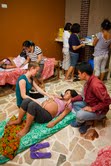
There is also a paddling pool available for water births, although somewhat hindered by the lack of hot running water. Rooms are big enough to allow family members to share the experience. There is neither stainless steel, nor bright lights, just soft chatter and female bonding over the imminent arrival of their babies; a half-way house between home and hospital. I find myself longing to go through the whole process again in this comforting, caring and innately familiar environment.

Deborah, like her mother, is a fine-boned, slender woman, whose willowy stature belies her inner strength, and both women sincerely support dignity, health and humanity for their patients. While she admits that hospitals definitely have their place, especially for difficult births, she believes that some hospital procedures are not in the women’s best interests, as they can be ‘invasive and interruptive’, while constant internal exams can lead to infection.

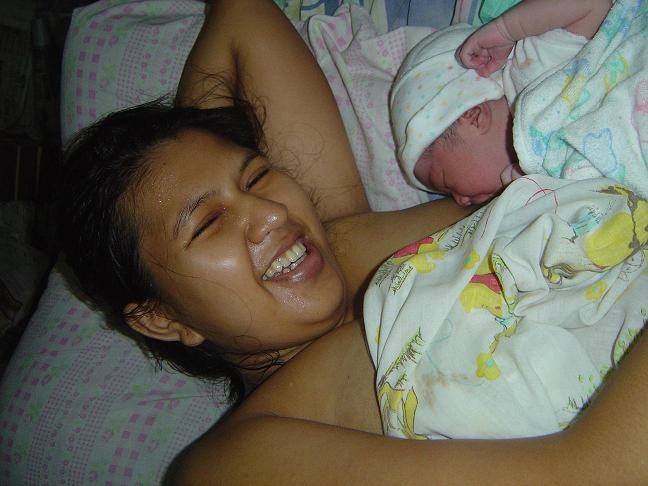
shiphrah.5Deborah and her mother believe strongly in self-control and choice: empowering women, and giving them the right to choose where and how, even if they have no control over when. Together they work to ensure a healthy, happy and dignified mother, and the birth of her child to be a safe, nurturing, and affirming event in her life, a privilege that we from more developed countries take for granted.

So count your blessings, and here’s to improving conditions for all women less fortunate than us.

*First published in ANZA News, July/August issue, 2013. Photos care of Shiphrah.

Posted in Local Culture, Philippines | Tagged , , , , , , | 1 Comment

Not-So-Jolly Boathouse

indexJolley’s Boathouse has been part of the scenery on the River Torrens in Adelaide since I was a child. I had not been there for years, but thought it would be fun to revisit it with my daughter, for a long reunion lunch, especially as it advertises itself as the ideal venue for a special occasion.

The weather was dire, the sky emptying itself prodigiously into the river, which was nobody’s fault, and while it stymied my plan for a post prandial stroll along the riverbank, it was actually pleasant to sit, cosy and warm within, looking out over the water, the black swans and the motor launches known as ‘Popeyes’ that cruise up and down from the Zoo to the Festival Theatre.

 We arrived early, but our hostess welcomed us in (albeit grudgingly) to sit with the menu and a G&T. Jolley’s has a terrific contemporary Australian menu with a lean towards the Moroccan/Mediterranean, created by Chef Tony Carroll, who apparently selects the finest local produce to accompany a wide range of Aussie and international wines. It seemed – used as I am to Asian prices – quite costly for lunch: more Sydney prices than I was expecting, perhaps naively, but all the more reason to anticipate splendid results.

We loved the look of everything on the menu, and took our time to order. My daughter finally chose the twice cooked duck leg with cabbage, peas and hazelnut salad, while I opted for the seared scallops and meatballs on celeric purée. I think she made the better choice – there was certainly more of it – and I was decidedly taken aback at the price I paid for 2 scallops and mash: Aus $21.50! Delicious though they both were, this seemed a preposterous price to pay.

After much debate, we finally decided to share the middle-eastern lamb shoulder, described on the menu as ‘slow braised for twelve hours and served with roast pumpkin, dates and cous cous with a Fattoush side salad’. At Aus $76 I expected it to be – to quote Mary Poppins – ‘practically perfect’. It was truly disappointing. We could not peel the meat from the bone as advised. Instead, tough and undercooked, and lacking any kind of sophisticated presentation, we were forced to saw at it. The salad was, well, lame. Fattoush is a traditional Levantine bread salad made from toasted or fried pieces of pita bread (limp and uncooked in this case) combined with mixed greens and vegetables according to season and taste. No taste in winter apparently.

Despite a lengthy consultation with the manager on the state of the lamb, we were not offered an apology, exchange, a reduced cost or even a free drink, although they did pack it up so I could take it home to cook it a bit longer, after advice that such a tough piece might not be improved with further cooking! I know, I would normally argue the case, but my kids are getting sick of me speaking out, even politely, in restaurants, so I reluctantly behaved in honour of our special outing. It was sad, though, as it was supposed to be a real treat. The setting, the nostalgia and the menu were all promising, but they failed to deliver and in the end we felt no inclination to stay on for dessert or coffee. Or to return. And apologies, I didn’t take photos, as I told myself it was not worth writing about. So I won’t…

Posted in Australia, Food & Wine | Tagged , , | 2 Comments

FermentAsian: the latest trend in Tanunda

FermentAsian.2 FermentAsian has rapidly become the hot spot to dine in the Barossa Valley for Modern Southeast Asian Cuisine. Open for lunch from Thursday to Sunday and for dinner, Wednesday to Saturday, this unique dining destination is set back from the main road in the heart of Tanunda, just over an hour’s drive from Adelaide.

In the two and a half years since it opened, the restaurant has already won several accolades, including Gourmet Traveller’s Top Ten Regional SA restaurants and Chef of the Year at The Advertiser’s 2012 Food Awards. Bloggers and journalists alike give rave reviews, and having heard about it almost a year ago, I had been eagerly awaiting the chance to drop in.

Spending a few days in the Barossa with my mother earlier this month provided the opportunity. Being winter, it was dark by five thirty, so despite an early six o’clock sitting (we had left booking till late, and it was now or never, so popular is this relative newcomer to the restaurant scene) we had to do several laps of the main street in Tanunda before we were able to spot the restaurant. FermentAsian does not look like your average Asian city restaurant with glass front and Asian window dressing, but resides in a lovely old Victorian sandstone villa with a wide veranda.

As the name suggests, it is a blend of Asian flavours, although the primary influence is Vietnamese. FermentAsian is owned by Vietnamese Chef Tuoi Do and Grant Dickinson, who defines himself as partner, wine person, musician. Tuoi Do explains her inspiration on their website.

‘The food at FermentAsian has its roots firmly entrenched in my Vietnamese heritage… To these traditional dishes we have added dishes inspired by our favourite Australian restaurants serving Southeast Asian cuisine.’

Tuoi Do not only supports local food producers, many of the ingredients come from the family’s own kitchen garden, managed and maintained by her parents, who followed her to the Barossa in 2010.

dining roomInside, the décor is  minimalist: red feature walls and large canvases covered in news print with red Vietnamese writing don stark white high-ceilinged walls. White linen clad dining tables with black chairs are laid out in the various rooms with plenty of space and we loved the eye-catching artwork by local photographer, Serbo-Australian Dragan Radocaj, which warmed up the somewhat austere atmosphere considerably. We were greeted by a genial staff member, who showed us to our table and made sure we were comfortably settled, indulging in a little repartee and opening our bottle of wine promptly.

Apparently the wine list is extensive and aims for diversity (rumour has it that Mr. Dickinson also works at Rockford’s), but my mother had been given a special  bottle as a birthday present from a wine maker buddy. Please note the only down side to FermentAsian: corkage is a steep $15 per bottle. So our gift ended up costing us quite a lot – particularly for a screw top! I will, nonetheless, look forward to exploring the wine menu on our next visit, particularly after reading Grant’s titillating introduction:

‘…Because the food ranges from dishes of great subtlety and delicacy to dishes with robust, spice-laden (though rarely fierce) flavours, I have tried to select wines which pirouette rather than stomp; I have deliberately avoided the lead–footed, the over-extracted, the over-ripe, and wines with high alcohol or obvious oak pulling focus.’

How to resist, if such lovely, poetic language is a reflection of the quality of the wine..?

As there were only two of us, we decided on the tasting menu in order to sample and appreciate as many of Tuoi Do’s highly praised dishes as possible. We had been warned not to overdo the rice, as the dégustation menu is long and filling, and this certainly proved to be good advise.

 Our first dish, presented by our gregarious and enthusiastic waitress, Maddy, was a June 458caramelized Berkshire pork in fresh betel leaves ‘with incendiary components’ (aka spicy, but again, I was impressed by the imaginative use of language).

 The heart-shaped, peppery, wild betel leaves proved to be a bit of a Vietnamese favourite: the grilled wagyu beef was also wrapped up in them. A mild stimulant with medicinal properties, betel leaf has long been popular in SE Asia for wrapping around bite-sized parcels of meat. We devoured them all, trying not to eat too fast, wanting to savour every beautifully balanced mouthful.

 Another Vietnamese favourite are Hanoi spring rolls, which were filled with fresh herbs (presumably from the family’s veggie patch?) and served with traditional Vietnamese dipping sauce: a light and cheeky mouthful. Maddy popped by to make sure all was well with our food, pour us more wine and amuse us with her light, happy conversation.

 Dinner flowed on through a fabulous grilled Barossa Black Angas Beef salad with beansprouts and my favourite zesty tang of lime juice, and a platter of perfectly June 460cooked and crispy Berkshire pork belly with ginger and orange sauce.

 By the time we reach the red duck curry with lychees and pineapple – perhaps more Thai-with-a-twist than Vietnamese, but nonetheless delicious – we had slowed down to a crawl, despite minimizing on the rice, and ended up taking a large portion of it home with us.

Yet despite our sated stomachs, we still craved a little sweetness, and we debated over the lime brulée, a chocolate and lemongrass mousse, or black sticky rice and caramelized banana. These may not be traditional Asian desserts, but the ingredients were Asian, and the combinations sounded irresistible. We succumbed to the lime brulée with two spoons, the lime effectively cutting the usual creamy sweetness in half and providing a flawless finishing touch.

All in all, our dinner was an unmitigated success, and FermentAsian proved the perfect place for a significant birthday celebration. The décor had a cool, statuesque elegance, the staff were amazing and made us feel as special as if we were at a private dinner.  And the food was fabulous. We relished every last mouthful, and I can’t wait to go back!

*Photo of FermentAsian’s dining room care of Google Images.

Posted in Australia, Food & Wine | Tagged , , | 1 Comment

Mooching with Mum in the Barossa Valley

South Australia 527

Despite my family’s tendency to avoid centre stage and keep every celebration low-key, my mother’s seventieth birthday earlier this year seems to have been  worthy of an unusual degree of fanfare. As I was up in Manila and missed the various lunches, drinks parties and dinners held in March, I promised belated birthday revelry when I came to Adelaide in June. And so it was.

Three nights in the Barossa Valley, just the two of us, which – I love modern technology – I  had researched and arranged over the internet before I arrived in Australia. I hadn’t spent much time there since working on my thesis four years earlier, and I was  looking forward to popping in again. We headed out through the Adelaide Hills on a fresh June morning. It’s a really lovely drive, especially after years of believing the only way to the Barossa was along the Main North Road and through Gawler –  never the most scenic of experiences. We arrived at The Pheasant Farm on the outskirts of Tanunda in time for lunch.

The Pheasant Farm came to life in 1973.  Maggie and her husband Colin Beer had moved to the Barossa Valley from Sydney and begun raising pheasants on their property near Nuriootpa. Unfortunately, no one knew what to do with a pheasant, South Australians being more familiar with lamb and beef. So Maggie taught them. A self-taught cook, restaurateur and writer,  Maggie Beer has since become an iconic Australian foodie.

The restaurant is a thing of the past, one I am sorry to have missed, but the Farmindex Shop is now a mecca for Maggie Beer’s many fans.  While it is no more than an outlet for Maggie Beer products and there is nothing here that you won’t find on supermarket shelves, it is in a beautiful rural setting.

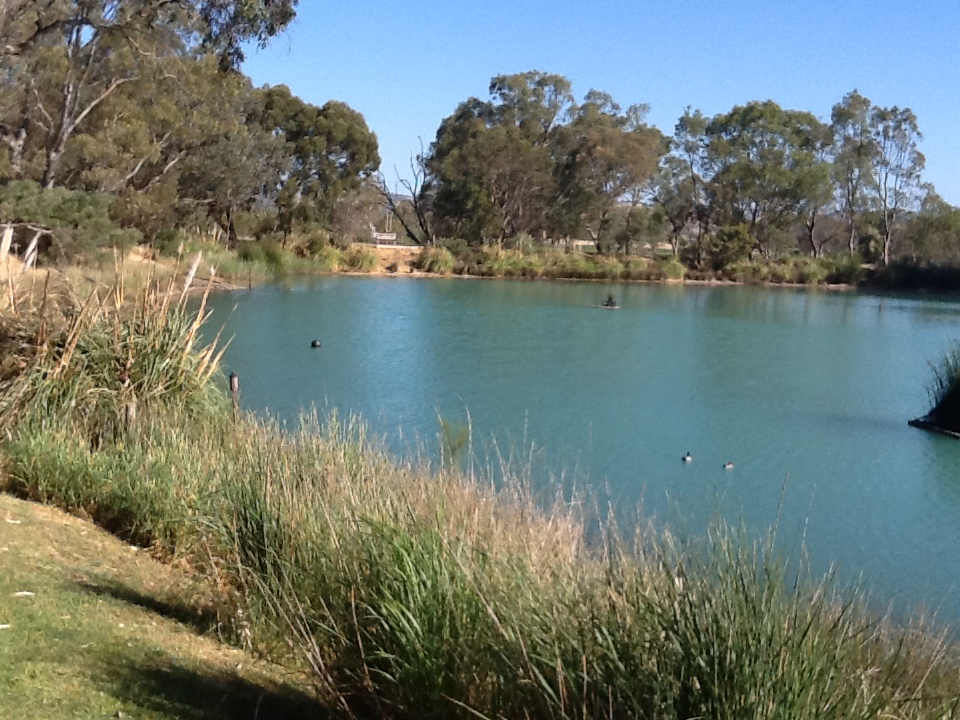
The shop sits above a deep, glacier-blue dam. If you are there at the right time of year, you can watch the extraordinary long-necked turtles from the deck, or wander along the gravel path that circumnavigates the dam. Beware high heels, however, the gravel can be life-threatening to weak ankles. (Yes, I speak from experience, how did you guess?)

Behind the car park is an aviary full of display birds: stately, elegant peacocks and glorious varieties of pheasant that will not end up in the pâté. A golden pheasant, with a headpiece like an Egyptian prince, struts his stuff for a seemingly myopic and distinctly ‘Plain Jane’ partner not remotely impressed by his extravagant flirting. A silver pheasant glittered like a newly minted coin. Another had feathers of Thai silk that shimmered into life as he spun on his heel and presented a back like a black opal, the shimmering black feathers burnished with patches of saphire green, cobalt blue and blood red.

Lunch was advertised as ‘picnic fare’ but consisted only of a small basket containing one of Maggie’s pâtés served with a couple of small, bland white rolls, a tiny dish of kalamata olives and something called freekeh* salad, which was less than memorable, that we ate off  old fashioned tin picnic plates for the princely sum of $15, accompanied by a bonus glass of Pheasant Farm Tempranillo. Feeling peckish and chilled, we ordered the day’s special too, which I have to say was an improvement on the picnic basket. This bowl of rich pheasant and hazelnut soup  was perfect comfort food for a light winter lunch, and also the only sample of fresh farm cooking. One on-line reviewer asked indignantly how Maggie Beer could ‘evangelise about fresh simple food on TV, and serve mass produced, fast food in her cafe’? I am inclined to agree.

MB.1After lunch, we joined about twenty other eager visitors to watch a short cooking demonstration on how to improve your roast veggies using vina cotta and verjuice, or just gallons of butter. As Maggie warns you on the display on the way in, she has never been about fads or health, but all about taste. And you’ll get no argument from me – although it was probably lucky that we were sharing those delicious, heart-stopping mushrooms with twenty others! The cooking demonstrations are staged in the reconstruction of Maggie’s home kitchen that was used for the popular four year series, The Cook & the Chef, which Maggie co-hosted with Adelaide chef Simon Bryant.  The set is nostalgically familiar for fans of the show, and when we visited three years ago, my then Maggie-obsessed son was delighted to be photographed at the kitchen bench. Yet I have to admit to a sense of disappointment. This demonstration was all too brief, and it was really only a marketing tool to advertise Maggie’s fetish for verjuice and vina cotta.  And while our instructor was very sweet, there was, of course, no sign of Maggie herself.

It is, nonetheless, a great spot for those who enjoy Maggie’s products and who loved the TV show. It is fun see the set and check out all her products in such an attractive location – and with the chance to taste everything as you shop, an opportunity thatMB2 isn’t offered at either Coles or Woollies! Also, the staff makes great coffee and is happy to answer all your questions. And of course, before you leave, you can stock up on bags full of verjuice, vino cotto, fruit pastes, pâtés and ice cream… and any of the Maggie cookbooks you are missing!

*Freekeh, by the way, is an ancient, high-fibre grain, related to bulgur and native to Lebanon, Jordan, Syria and Egypt. The green wheat grain is roasted, giving it a smoky aroma and a nutty, toasted taste. The name freekeh is derived from the Arabic word al-freek meaning “rubbed,” which refers to the rubbing of the grains to remove the husks.

*With thanks to Google images, apart from my own photo of the dam at the Pheasant Farm.


Posted in Australia, Food & Wine, Travel | Tagged , , , , | Comments Off on Mooching with Mum in the Barossa Valley

Afternoon Tea on the Quay

sscq-high-tea-200x300Anyone for scones?

Yes, I do realize it is starting to look as my life is nothing but clotted cream and champagne, but there you are, that’s just the way it goes… for some! This tea was for a very special occasion, as the nine Shire Princesses I had hosted at the Shangri La, Makati last year were returning the favour, and had arranged afternoon tea at the Sir Stamford Hotel in Sydney, just above Circular Quay.

 So there I was, dragging my heavy suitcase from the bus depot at Central Station around the circle line to Circular Quay, where I caught an elevator and trudged up Macquarie Street to the red carpeted entrance of the hotel. Feeling decidedly hot and bothered, I was a little put out when no one rushed to greet me or help with my case, until I realized the entire staff was distracted by the Miss Universe competitors gathering in the lounge. Sparkling dresses in a rainbow of colours and styles hugged tall, narrow frames, topped off with billowing curls and ringlets. I felt suddenly understated, despite the twinkling tiara I had donned to meet up again with the princesses.

Still lugging my case, I found my way to the bar, and sank down, exhausted, onto a heavily cushioned sofa before an open fire. The Sir Stamford Bar was a haven of old-fashioned elegance:  large oil paintings and portraits hung on walls upholstered in smoky-blue and silvery-grey flock fabric. Deep tapestry sofas faced tall, narrow windows overlooking the botanic gardens. A modern take on the traditional Russian samovar stood in stately splendour beside the long, polished, dark wood bar. Lamp light gave the whole room a cozy ambience.

As I waited amongst pots of white orchids, I read the menu, which told the oft-repeated tale of the Duchess of Bedford and her social experiment to introduce merienda or afternoon tea to entertain her girlfriends and indulge in small talk at the family estate, Belvoir Castle, during the long gap between luncheon and dinner.

Just like the Duchess and her friends, the Princesses and I happily followed the request to ‘indulge in a timeless tradition,’ as we took our places at the table for an hour or two of girly chit chat. I was somewhat bemused by a midday ‘high tea,’ but as I had come off a three hour bus trip from Canberra and hauled a heavy suitcase across Sydney, I was not about to complain when the three-tiered tea tray that arrived in time for lunch. Our waiter was full of old-fashioned courtesy, like the family butler, and suggested in polite and unhurried fashion that we might like a glass of champagne while we waited for the tea to arrive. The idea was greeted with alacrity.

There were various options for tea listed on the menu:  Traditional High Tea; a Deluxe Devonshire, and even a special high tea for children with ‘a fluffy homemade scone… mini desserts and traditional finger sandwiches served with a glass of juice or hot chocolate’, but the princesses had already ordered the ‘Elegance High Tea, with all the usual delicacies, as well as a flute (or two) of Moet & Chandon. I simply sat back and prepared to be gastronomically pampered.

Too often I find the savoury options are overshadowed by the sweeter offerings, but much to my delight this was not the case today: fresh ham and Dijon mustard sandwiches; a delicate slice of smoked salmon rolled in caviar and horseradish on a baguette slice; a roast chicken and tomato roulade; the deliciously famous Stamford curry puff; minced pastrami with tomato salsa in a pastry cup, and Mediterranean roast vegetables served on an oatcake spread with goat’s cheese that I saved to the end. It was undoubtedly my  favourite and left me utterly satiated (that’s a polite term for ‘stuffed!’). I would have been perfectly happy to finish there, but of course, one feels obliged to taste the cakes, too.

The macaron – no “double-o” apparently – is a melt-in-the-mouth French confection of eggs, ground almonds and icing sugar, in a wide range of flavours and filled with ganache or buttercream. The name comes from the Italian word for meringue, macaroni, and is often mistakenly spelled macaroon, which is, in fact, a small snowball of egg whites, almonds and coconut my mother used to make on baking paper that would add a certain gluey chewiness to the finished product. Our macarons were much more élégante and there was fortunately no sign of baking paper .

A chocolate mousse slice filled with caramel on ginger bread was far too rich for me, but the royal ladies loved it. I found a little room for the strawberry and vanilla financier (a rich almond cake, traditionally baked in the shape of a gold bar), and the  ‘blue velvet’: a white chocolate mound with a jammy, blueberry centre, but as always I preferred the light, fluffy scones served with whipped King Island double cream and jam. and these were the best I have tasted in a long time. To complete the banquet there was, of course, a choice of teas or coffee.

I will refrain from complaining yet again about the difference between high tea and afternoon tea, as ‘High Tea’ appears to have crept indelibly into the vernacular. So be it. I admit defeat, albeit ungraciously. Anyway, whatever you want to call it, Afternoon or High, it creates the perfect excuse for An Occasion or A Girly Gathering, complete with the sort of treats few of us would bother to prepare at home…not to mention the sheer indulgence of Moet in the early afternoon. And my sincerest thanks to the Princesses for a deeply decadent afternoon…

 Photo borrowed from http://www.stamford.com.au/ with thanks.

Click here to Reply or Forward
24% full
Using 2.5 GB of your 10.1 GB
©2013 GoogleTerms & Privacy
Last account activity: 17 hours ago

Details

Posted in Australia, Food & Wine | Tagged , , , , , , | Comments Off on Afternoon Tea on the Quay

Massages and Mayhem

255710_110325090609520_STDSomewhere on Mindoro…

I am lying naked as a chicken fillet on a butcher’s block, on top of a large black plastic garbag, peering through a hole in the bed to a pile of pebbles artistically arranged on the floor for our entertainment. There is a strong whiff of those banana lollies we used to love as kids. Apparently I am about to be scrubbed down with lotions and potions scented with this rather sickly perfume. I have never before succumbed to a body scrub, but I have been told to relax and enjoy…

An hour later I am wrapped like a corpse in a body bag, still reeking of banana lollies, and steaming like a baking chook. Beside me is my new best friend – it’s amazing the secrets you’ll share with an almost-stranger lying naked on a slab – who is equally well encased in lotions, potions and black plastic. I am starting to feel overheated and claustrophobic. At last we are unraveled and told we can take a shower to wash off all the goo. We stumble groggily into the next room to be greeted by a large, bubbling spa bath. A little dazed, I find myself standing knee deep in the bath before reality hits: I am expected to sit in the spa, stark naked and face to face with my new Bestie, rinsing off sixteen layers of banana paste. Call me a prude but this is a little too much stark naked reality for me.

“I thought there was a shower,” I croak.

“Yes, ma’am,” nods the masseuse, reaching for a hand-held shower attachment on the wall.

“No way!” I babble, frantically. “I need a proper shower. Have you got a separate shower?”

“Yes ma’am,” says my poor masseuse, slightly confused by my reaction. I stagger out of the spa bath and down the steps to the tiled floor, where the inevitable happens. Slick, creamy feet collide with shiny, wet tiles and my body disappears suddenly from under me. Gripping desperately onto a tiny corner of my towel, I find myself spread-eagled on the floor, trying to slide my ankles together, my elbow and left bosom throbbing from their respective collisions with the steps.

The masseuse is incoherent with apologies; I am incoherent with shock and embarrassment. Somehow she drags me to my feet and propels me next door to the shower room, as I shake like a leaf, still uncertain whether I am going to laugh or cry. Instead, I sigh with relief, as she turns the tap on a proper shower and leaves me to it… and the water trickles brownly from another of those small shower attachments. I drop my towel and fiddle helplessly with various nuts and bolts, trying to transfer the water to the larger, overhead shower, but there isn’t an obvious answer. In despair I lean around the door.

“Excuse me, can someone show me how to make the shower work?”

And before I can say ‘abracadabra’ the room is full of three fully clothed masseuses and a young male workman. In slow motion I look down and realize I am in one of those popular nightmares where everyone is dressed but me. I begin to squeak like a frantic guinea pig. They all look at me in surprise, as I try to grab for the itsy-bitsy towel scrunched on the floor by their feet. Attempting to restore some dignity – pointlessly – with this tiny scrap of fabric, I gesture at the workman.

“There’s a man in here,” I squeak, stating the bleedin’ obvious. The girls look bewildered and I watch as the penny drops. They all start to giggle helplessly, including the workman.

“Is OK ma’am,” they all try to reassure me, “he’s gay!”

I find this not a jot reassuring, but the shower is running properly and my rescuers traipse out, still giggling. I emerge five minutes later, clean and shiny and still a bit shaky.

“Relaxing? Hell!” I chirp at my new Bestie, ensconced in an armchair awaiting a foot massage. “I need a Margarita!” You ladies are most welcome to your spa days, massages and body scrubs. Enjoy, indulge, relax to your heart’s content, but they are not for me, I will not succumb to such suggestions again. I’m off to the bar, where I can relax and enjoy in fully clad peace…

* Photo care of Aninuan Beach Resort, Mindoro

Posted in Lifestyle, Philippines | Tagged , | 1 Comment

“The Grounds” in Rural Alexandria

Sydney Day 1 100I hit ‘The Grounds’ running, straight off the plane from Manila, and was astounded, in my jet-lagged stupour, to discover this rustic café located in semi-industrial Alexandria, only minutes from the airport, the site startlingly at odds with its surroundings.

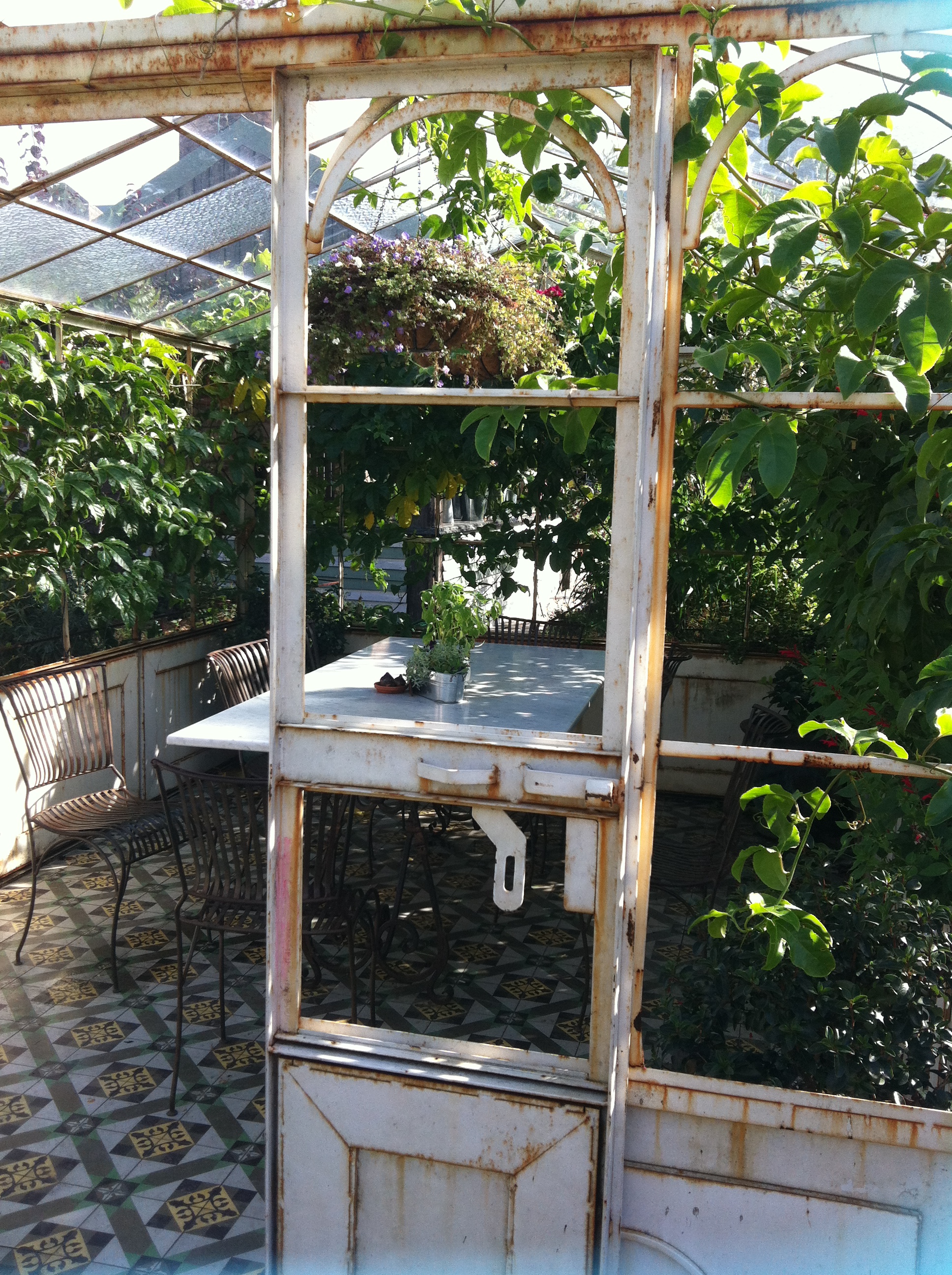
The Grounds began life as a pie factory in Sydney’s inner west in the early 20th century. A hundred years on, it has been transformed into a smart café, a coffee research facility, a kitchen garden and an attractive courtyard dining area, maintaining a sense of its industrial heritage with black, steel frames, rustic woodwork and open brickwork.  The attention to detail is mesmerizing.

‘The Grounds’ has been a family project, created by food industry entrepreneur Ramzey Stoker, his sister, interior designer Caroline Stoker and co-Director and coffee expert Jack Hanna.  Executive Chef, Lilly Fasan, works hand-in-hand with horticulturalist Erin Martin to grow quality, seasonal produce, her menu emphasizing healthy home-style cooking and fresh ingredients. Heirloom vegetables, edible flowers, fragrant herbs and fresh fruit are grown in planter boxes made from recycled railway sleepers.

This miniature mid-city pastoral landscape is a little twee, but who can argue with an attempt to prettify a dreary old red brick factory with pergolas, vines and a painted pig sty? One review described ‘The Grounds’ as a theme park, and I see their point, but to me it recalls the glories of a walled kitchen garden in an old English Manor house. What would you call that? Rustic whimsy?

Parking isn’t easy, even on a Friday, but we walk up an appetite over three or four blocks. Apparently the weekend queues are horrendous, so I am grateful for a peaceful Friday morning.  It’s still thrumming with life, but we waited only a few minutes to get an indoor table – luckily an earlier cloudburst had cleared and we sat beneath a chilly but clear blue sky. Ensconced at a table near the kitchen, we watched the hustle and bustle of the kitchen staff through a wide hatch. As I wandered past in search of “The Chooks,”(aka the Ladies)  I paused to chat with a woman creating tamarillo tarts.

Mistaking them for a tomato variety, I was told it is actually a temperate South American fruit now cultivated in New Zealand  – and apparently in the Philippines. How did I miss that? According to Wikipedia, it is actually known as the tree tomato to most, but the New Zealanders wanted a more exotic  sales pitch and invented tamarillo by blending the word “tomato”, the Spanish word “amarillo”, meaning yellow, and a variation on the Maori word “tama”, for “leadership”. Sydney Day 1 096 Whatever its name, it made a very pretty tart on a bed of soft cheese, and I was only sorry they weren’t prepared to let me test it. I did manage to snitch a small piece of discarded tamarillo, though, that was unexpectedly tart. Serve me right, I guess!

Breakfast arrived promptly: poached eggs and toast with feta cheese, heirloom tomatoes, ham, pesto and avocado served up  on a wooden platter. Nervous of undercooked eggs, I ordered them well done. They took me at their word and presented me with two of the hard-boiled variety. Never mind, I mixed them up with the cheese,  avocado and pesto, and created a delectable spread for the crispy sourdough toast. And oh! The joy of a flavoursome, creamy  avocado instead of the rubbery, tasteless Filipino variety.

After our filling brekkie-on-a-chopping-board and a couple of good coffees, we wandered out to explore the grounds of ‘The Grounds,’ passing the  coffee roasting room where classes are held to take you through the coffee making process.

An expensive, but irresistible grocery store lords it over another corner of this expansive site. Salt, Meats, Cheese houses all sorts of  imported luxuries, including a delicatessen whose counter is crowded with large wheels of hard cheeses, the ceiling  draped in cured sausages and salami like meaty chandeliers. There are fresh pastas and fresh peanut butter – we watched a young woman using a press like one I have seen in the Philippines for crushing coco beans into chocolate paste – while huge rocks of pinkish salt litter the counter space.  Apparently they offer the highest quality products from the best international suppliers at wholesale prices. Mmmm… it still seemed pretty pricey to me.

Back near the café, beside the kitchen garden, we find a handful of shy chooks and a piglet called Kevin Bacon – memories of Wilbur that Radiant pig – who gets a good scratch and lounges in Roman splendour for a photo. Little does he know…

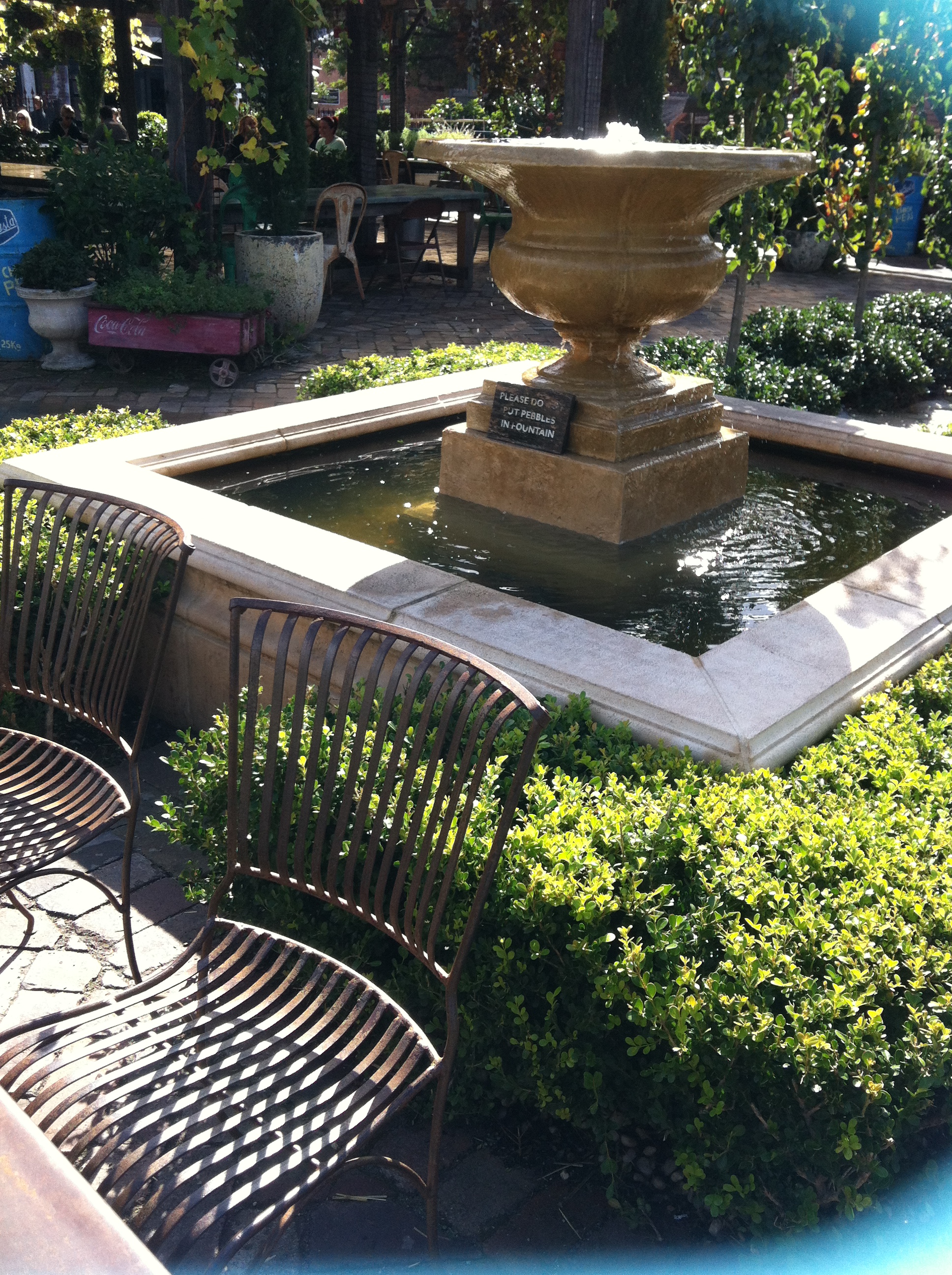
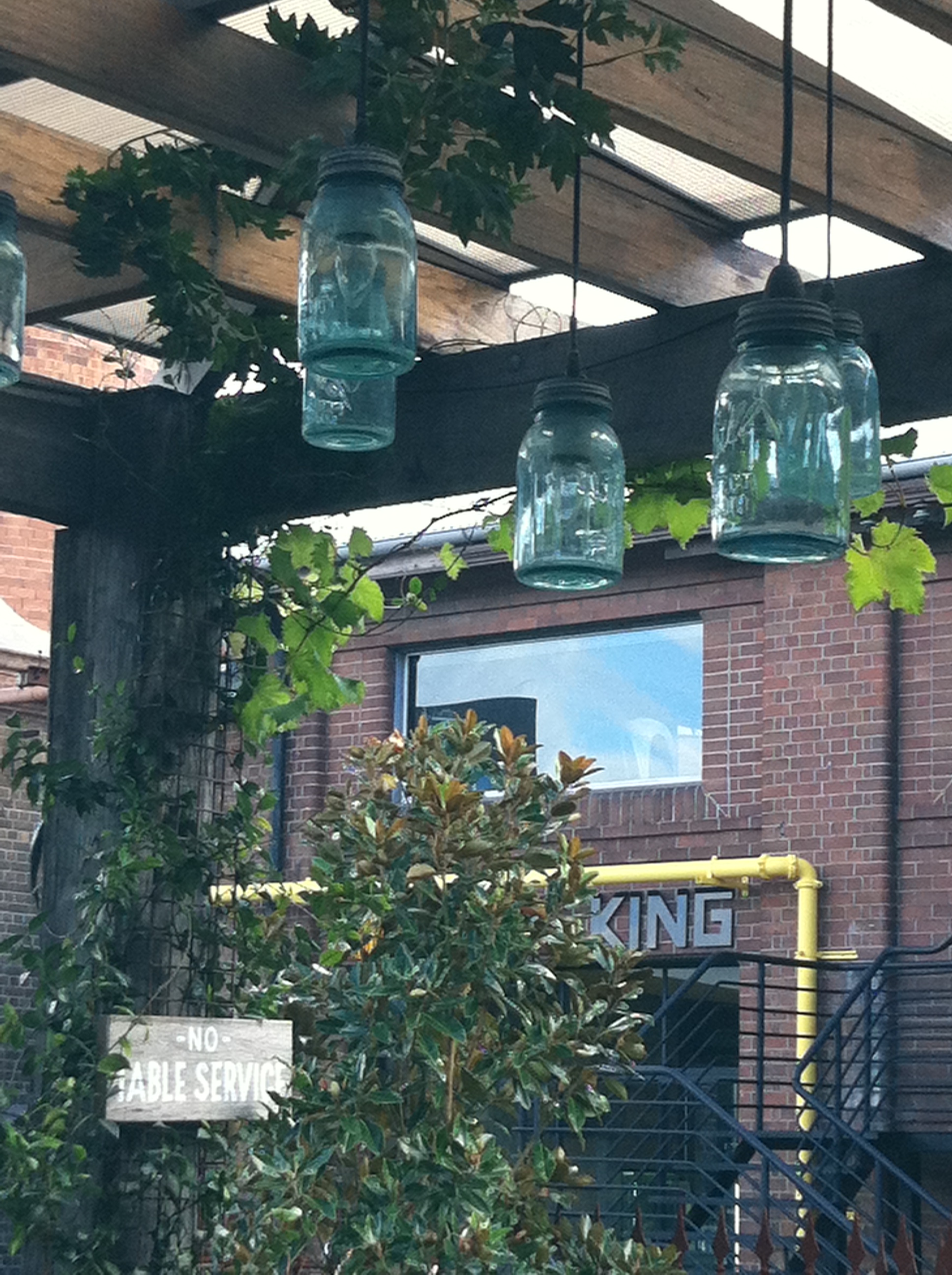
We meandered on, beneath a pergola dripping with vines and strung with lamps Sydney Day 1 109made from old jam jars, the courtyard scattered with an eclectic collection of outdoor furniture. For small kids, there is a ditsy playground complete with Wendy house secured by a painted picket fence. A row of blue pots on a shed roof sprout fresh herbs, and a French provincial-style fountain mutes the noise of passing traffic.  It truly felt like a secret garden concealed withinan industrial landscape.

The Grounds is open seven days a week: weekdays 7am-4pm, weekends 7:30am-4pm.  If you visit on the weekend, be prepared to queue.

Posted in Australia, Food & Wine | Tagged , , , , | Comments Off on “The Grounds” in Rural Alexandria

Farewell Tea

tea.1The bane of expat life is the constant ebb and flow of friends. Every year, about this time, I start deleting names from my cellphone, as a clutch of my old mates disperse to new postings, and the talk revolves around moving companies, garage sales and new schools for the kids. The diary is filled with farewell drinks, dinners and final play dates, and of course I have to arrange the odd afternoon tea as a grand finale.

Raffles has recently arrived in Makati, complete with a copy of the original Singaporean Long Bar where – for some mysterious reason – customers are invited to fling peanut shells around the floor, and the Singapore Slings give the afternoon a truly misty quality. In the Writers Bar – ‘created as a tribute to the the host of literati who have stayed at or written about Raffles’ – they serve afternoon tea with REAL clotted cream, an essential part of any true cream tea. It seemed a fitting place to say goodbye to a good friend who has been part of the scenery since we first arrived in Manila.

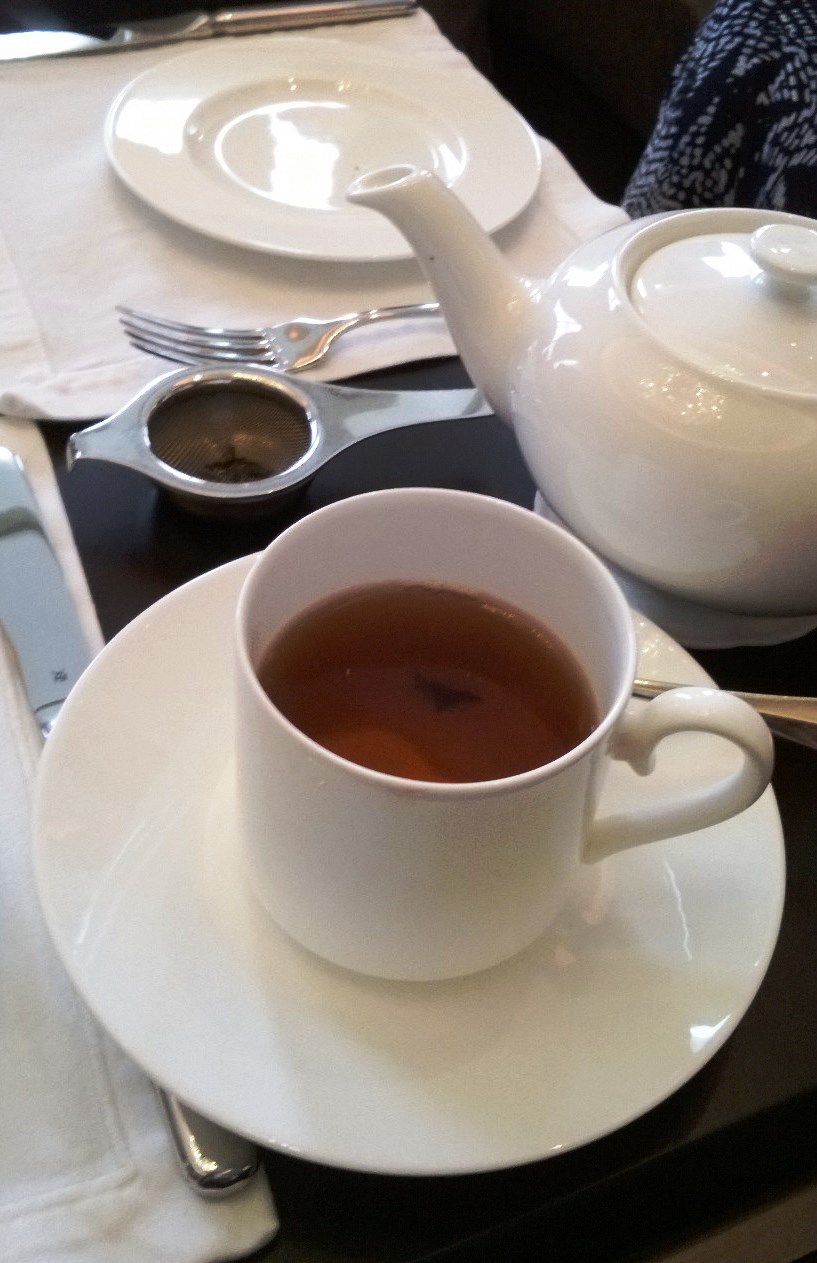
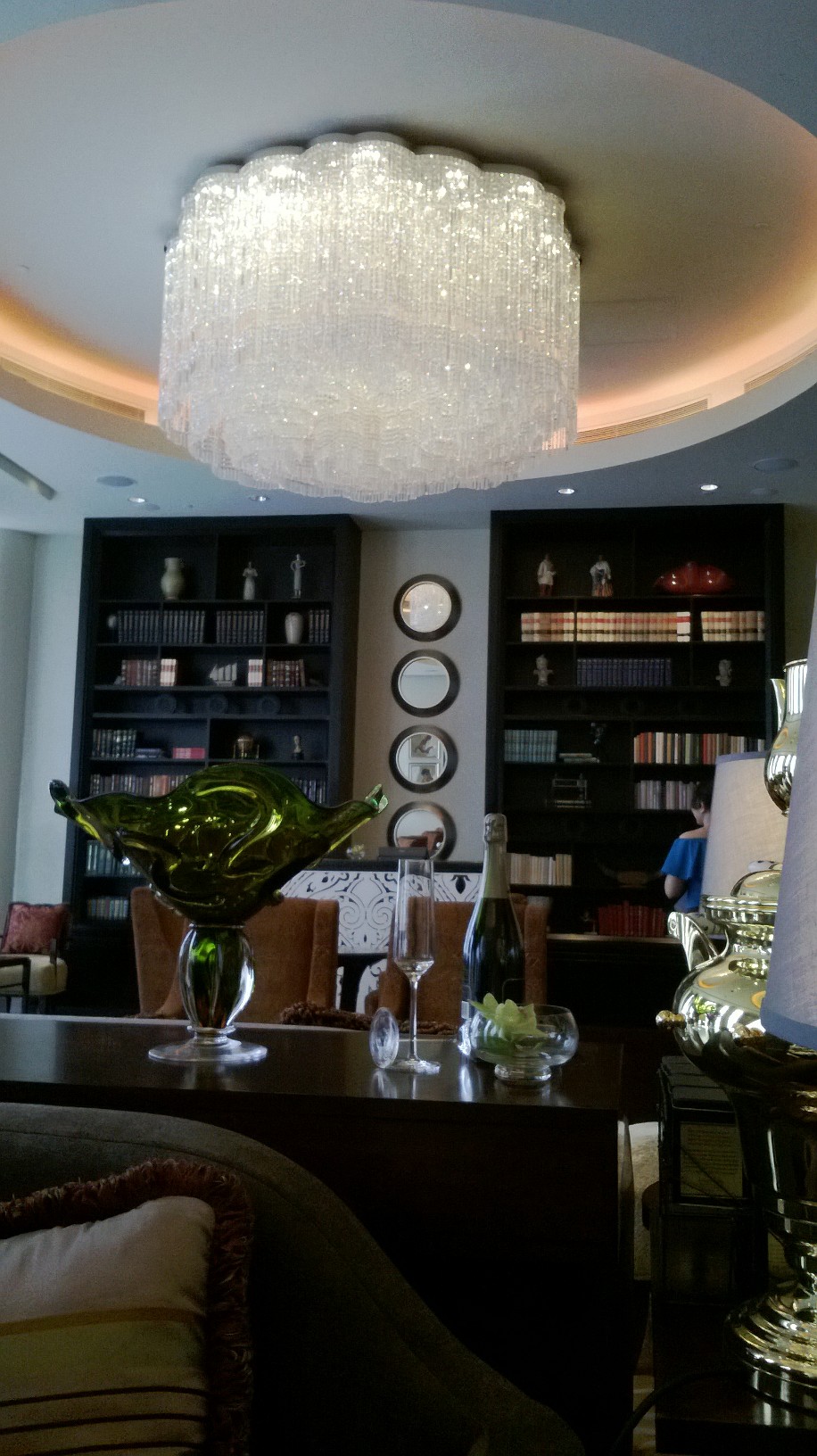
tea.2So last week a group of us gathered in the Writer’s Bar, just off the main lobby, armed with tissues and a boxed Pinatubo teapot as a keepsake. (Valet parking is still free, which is a lovely little luxury, but be prepared for a lengthy wait when you want it back.) As we were ushered through the main entrance, our first glimpse of the lobby is striking: modern chandeliers of dripping ice crystals that look like Christmas have been blended with floor-to-ceiling bookcases filled with ancient tomes no one will probably ever read. There is also some great artwork and a couple of eye-catching statues to entrance you. The atmosphere at Raffles is one of refined elegance, the waitresses are calm and quietly spoken, and the afternoon tea is practically perfect – although I did cringe at being handed a knife and fork to eat a sandwich.

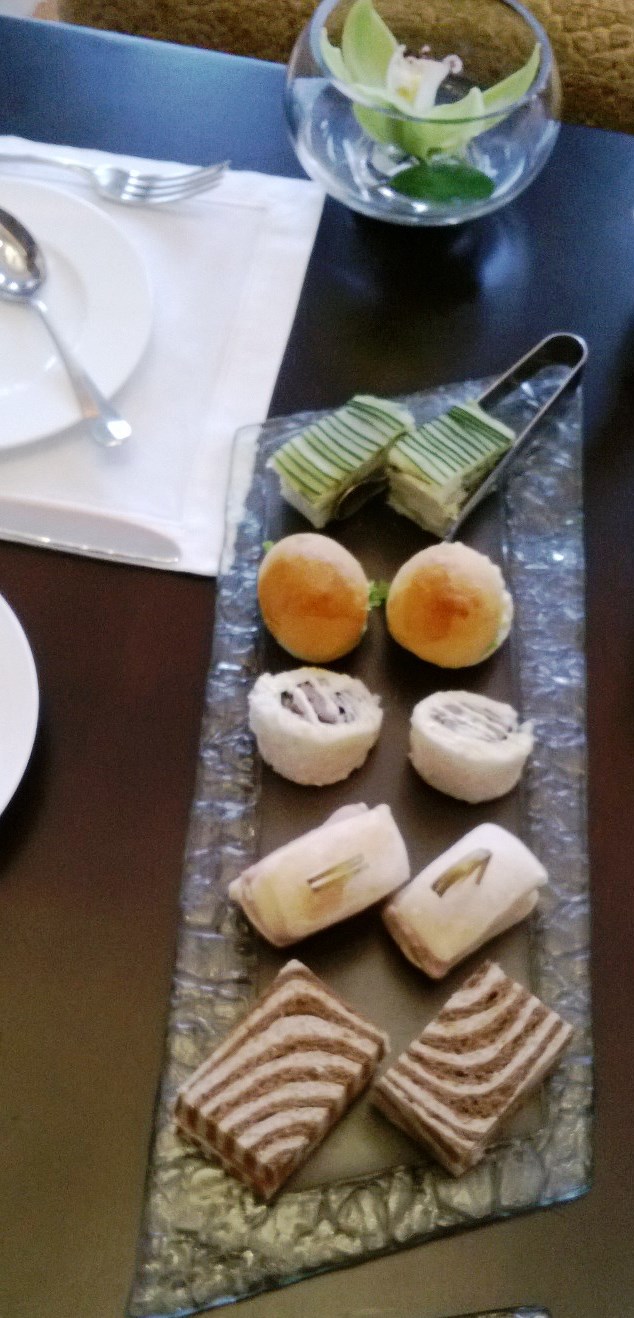
Tea for two at 995 pesos (20US$)  is a reasonable price for Manila, and you definitely get your money’s worth: smoked salmon on an eye-catching marbled tea.3bread;  a bite-sized egg brioche; a cucumber delicacy designed like a piece of art; a small, fresh ham roll, and a beef wrap amuse bouche are all arranged two-by-two on a long glass platter.  There are medium-sized scones – although I would love them to have been warmed up – with proper Devonshire clotted cream that you could eat with a teaspoon. And the three-tiered tray of cakes was fit for the sweetest Filipino tooth with a huge array of brightly coloured macaroons, morsels of rich chocolate cakes and profiteroles shaped like snowmen.

A pianist played wistful music on the grand piano in the corner. She almost drowned out our conversation, but we just talked louder. We decided not to share champagne for a change, as the price per glass was prohibitive at 900 pesos for a doll-sized glass only half-filled. Albeit they were top quality bubbles, I would prefer a cheaper bottle in a larger glass, as the former would had evaporated into the ether before the froth had settled. Instead, there was a lovely selection of teas to choose from, and as we sipped in a lady-like manner from deep armchairs and cushion-strewn sofas, the sandwiches and the scones quietly disappeared. Later, our teenagers would enjoy the box of sweeter offerings we could not manage, so everyone was happy, and hopefully my dear friend has a lovely memory to take home with her…

Afternoon tea is served daily in the Writer’s Bar from 2.30 – 5.30pm

For reservations please call: +632 555 9777
Email: dining.makati@raffles.com


Posted in Food & Wine, Lifestyle, Philippines | Tagged , , , | Comments Off on Farewell Tea

Memories of Manila (1)

Jenny WallumJennifer Gordon-Russell, a.k.a. Jenny Wallum, first arrived in the Philippines in the early 80s with her economist husband Peter Wallum and younger daughter. These were the years of martial law and the Marcos’s sovereignty; the days when traffic was light and spouses of ADB staff were not allowed to work in the Philippines. Jennifer may not have wanted to take on a presidential dictatorship but she was not willing to put up with the dictates of a bank. She was told to go home if she didn’t like it. “Home is where your husband is,” she insists. And eventually, with help, she persuaded the bank to let her work, and has stayed firmly at her husband’s side ever since.

In the meantime, she established a pre-kindergarten class at the British School Manila (BSM) for 4-5 year olds. Back then BSM was a simple, low level building on spacious grounds in Merville Park, somewhere behind Nomads, and there she taught these kids to read and write, a role she truly loved.

Jenny also loves to write poetry, and has even published a short book of poems, many about her experiences in the Philippines. Her profile page made me laugh at her acute self-analysis:

…’raised in a senior boys Approved School ensured that originality of thought, tenacity and totally annoying behaviour started early.’

This learned behaviour was enhanced by the fact that she was born of mixed ancestry in the north of England, a region renowned for its spirited individuality and feisty attitude, which Jenny has in spades.

Jenny and Peter have lived through all the natural disasters of the past thirty years in Manila: the earthquake that measured 7.8 in 1990 and killed almost 7,000 people; the eruption of Mount Pinatubo in 1991, and Typhoon Ondoi in 2009, which dumped more rain on Quezon City than Hurricane Katrina did on Louisiana.

Out of Pinatubo came a new phase in Jenny’s life, organizing EVAC Foundation (Entrepreneur Volunteer Assistance Charity) which helps the indigenous Aeta, reputedly the earliest inhabitants of the Philippines, who had been living in the forests and mountains of northern Luzon. Pinatubo’s rivers of lahar swept them dramatically from the forests and a way of life they had enjoyed for thousands of years, and cast them adrift in the twentieth century. The EVAC Foundation has developed a range of training and micro-loan programs, educational scholarships, adult literacy and livelihood projects.

We also talked about the People’s Power Revolution in 1986 which deposed President Marcos and restored democracy to the Philippines.  Expatriates had been warned to stay away from EDSA as General Fabian Ver, Marcos’s Chief of Staff, was threatening to fire on the protestors, so they watched everything on local television. “We stayed on for the revolution and every coup that followed” she tells me. “We did not run away.”

Jennifer remembers yellow ribbons tied on every tree in memory of assassinated Senator Benigno ‘Ninoy’ Aquino and as a symbol of the EDSA People Power Revolution.

She also remembers climbing over the back wall of the Magallanes estate to watch the rebels strafing the runway at Villamor Airbase. When I asked if she had been scared, she told me that she had never been afraid. “I felt that I could trust the Filipino people…  I felt [they] were above base cruelty.

We sit in her den, sharing the sofa with her family of cats, and discuss how Manila has changed in thirty years. There were 10 pesos to the US dollar back then, she tells me. There were no shopping malls and only primitive supermarkets: SM was just starting up. Refrigeration was scarce even for meat and frozen goods. Fresh food was hard to come by. There were no high rise apartment buildings, and EDSA was a wide, open road with trees up the central strip. McKinley Road was almost deserted, a road that ended at the Fort Bonifacio army base, secured from the general public.

Despite the changes in the scenery, Jenny continues to stay busy and involved, displaying a humanitarian, pro-active patronage towards her host country that is incredibly inspiring. Her other long-standing commitment is more light-hearted. Jenny loves singing and has sung in the Asia Minors and her church choir for many years. Every year, on Remembrance Day, she leads a quartet in singing “I Vow to Thee My Country.”

Yet I find myself wondering which country she is singing about: England or the Philippines?

*Originally written for Inklings Magazine, May 2013

Posted in Local Culture, Philippines | Tagged , , , , | Comments Off on Memories of Manila (1)

Mother’s Day in Manila: saccharine or sincere?

Antonios 036

…yet though you dance in living light, I am the earth, I am the root, I am the stem that fed the fruit, the link that joins you to the night. ~ Judith Wright from ‘Woman to Child’

This year my Facebook page was awash with Mother’s Day message for at least three days beforehand: pictures of flower arrangements, special meals, loving salutations and heartfelt homages to mothers in general and our own mothers in particular.

Mother’s Day, like any festive day in the Philippines, is HUGE. And, doubtless with calculated forethought, the general election has tied in nicely with this Mother’s Day weekend, to ensure workers in Manila can go home to the provinces to vote not only for new leaders, but for the world’s best mum.

Mothers have been celebrated throughout history. The Greeks worshipped the mother goddess Cybele. In the UK, Mothering Sunday was originally a regional custom adopted by the Church of England in the 17th century as a worthy vernacular celebration that could be linked to the Virgin Mary and the Mother Church.

In the early 20th century, Anna Jarvis of Philadelphia held a memorial for her mother and subsequently began to campaign for a national Mother’s Day. She specifically noted that ‘Mother’s’ should be a singular possessive, for each family to honour its own mother, not a plural possessive commemorating all mothers in the world. By the 1920s, it had been universally adopted and post-World War II it gained further success as a commercial marketing tool, since when it has gone from strength to strength.

In some countries the date has been altered to fit in with local religious observances, such as Virgin Mary Day in Catholic countries, or Bolivia’s Mother’s Day which is celebrated on 27 May to commemorate the Battle of La Coronilla. This took place during the Bolivian War of Independence in 1812, when many women fought for the country’s independence and were slaughtered by the Spanish Army. China and some ex-communist countries usually celebrate the socialist International Women’s Day on March 8, rather than the capitalist Mother’s Day. In Thailand, Mother’s Day is celebrated on 12th August, the birthday of Queen Sirikit. In Ethiopia, Antrosht is a feast day honouring motherhood held on an unfixed date at the end of the rainy season.

My own mother refused to allow us to acknowledge it, especially once the day was disassociated from Mothering Sunday, claiming it was invented by Hallmark, purely commercial and therefore not worthy. It has indeed, become highly commercial, as the Filipino shopping malls will verify, but certainly no worse than Christmas or Valentine’s Day.

And I can’t help feeling that anything that reminds us to acknowledge and appreciate our partners, families, friends or even teachers, is not such a bad thing. While we never made much of it either, with our own children, I am forever grateful to the teachers who provided memories of handmade cards covered in wonky hearts (cut out with small clumsy fingers) or coloured handprints like autumn leaves . Cooling tea and Vegemite on cold, damp toast may hardly have been a gastronomic feast, but the effort put in by eager-to-please, Hobbit-sized children will always be appreciated, and I suddenly find it is more about the sweet memories Mother’s-Day-Past has left me with, as opposed to any sense of smug worthiness. This year my teenage boys cooked a three course dinner for eleven, with the help of three mates and a guitar all scrunched into our less-than-spacious kitchen. What’s more, they all helped with the washing up. A gift indeed! And what have these memories to do with commercialism?

My One & Only’s best memory – so well, and so often told, I feel I must have been there – was the acquisition of a chopping board for his domestically-uninspired mother, nonetheless acclaiming her “World’s Best Mother” by a nonjudgmental son. Some years later, it would break in half across his bottom, wielded by that same ‘World’s Best Mother,’ undoubtedly driven to distraction by her troublesome teenager. Well, we all have those imperfect moments!

A friend posted an article on Facebook entitled ‘Why I Hate Mother’s Day.’ The writer, the Scrooge of all days of celebration apparently, ridicules the sentimentalization of Mother’s Day – what a word! –  designed to make children feel obligated to buy presents and mothers to feel inadequate. Well, bah, humbug to her, I say! It is all in how you perceive it. For me, it is not about gifts or flowery words, duty or expectation; it is a day to focus on family. At our house, as the children get older, busier, and increasingly independent, we too rarely seem to find the time to be together. For me, it should not be about perfection or failure, inadequacy, complacence, or ‘Superior Beings’ as Ms. Scrooge suggests, it is simply an opportunity to hug your mum and to love her, warts and all. If your mother really was the Wicked Witch of the West, buy yourself a bottle of bubbles and celebrate your survival!

For the rest of us, it is one day in the year to remember your mother and to allow her the chance to celebrate her children in return. It is an opportunity to think of someone other than yourself and acknowledge that, for better or worse, your mother played a role in making you into the person you are today. If nothing else, she gave birth to you, and while that may be a natural function, it is still one hell of a gift that you can’t buy in a shopping mall!

Posted in Biography, Lifestyle | Tagged , , | Comments Off on Mother’s Day in Manila: saccharine or sincere?