
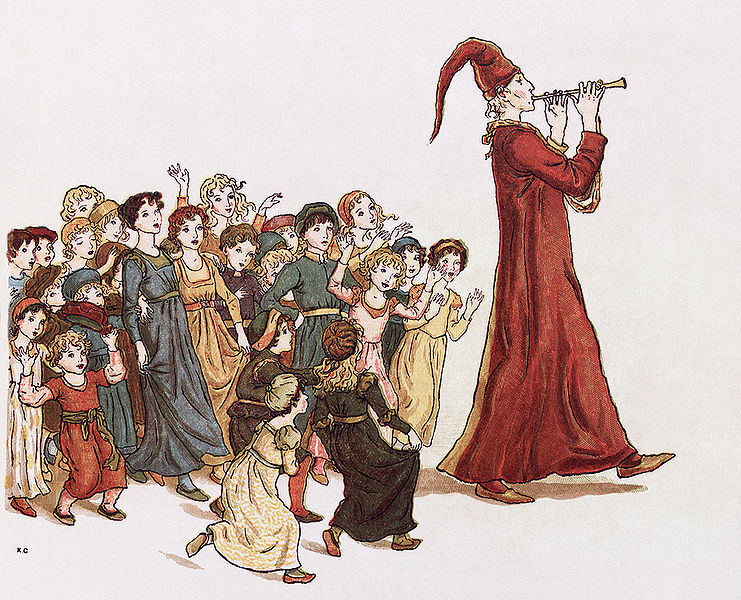
Remember the childhood fairy tale about a man with a flute, who lured all the children of the village away from their parents, after the townsfolk failed to honour their promise too him? With the best intentions in the world, something very similar happened to the children of Britain during World War II…
Last month, I was invited to take part in Evacuee Week.
Hosted by the Heritage Education Service at the Steam Railway in Havenstreet, each day was a re-enactment of the evacuation of over four thousand children from the mainland to the Isle of Wight, at the very beginning of WWII. The railway station became a set for local school kids to take a glimpse at the trials and tribulations of the war years, and specifically, what it must have felt like to be uprooted from their families and shipped off to strangers in the comparative safety of the English countryside. For four days in June, local schools, brownie packs, a group of enthusiastic home-schooled kids and more arrived at the station, eager to participate. Many dressed the part, in 1930s style clothes, carrying gas masks and small suitcases, and wearing large name tags pinned to their coats. Adult volunteers met them on the platform dressed as army officers, nursing staff, WI volunteers and land girls, to set the scene and welcome them to the island, encouraging them to imagine what life must have been like for children at the start of WWII.
Our resident dinner lady provided samples of some basic war-time snacks, such as potted-meat sandwiches and eggless cakes. Then she explained rationing, and there was many a gasp of horror at the thought of such limited amounts of food. In another room, a WI volunteer showed them a selection ‘make-do-and-mend’ toys from the era – a common cry during the war for both toys and clothes – and suggested ways to create their own. As the factories had to focus on the war effort, building real guns, tanks and airplanes would take priority over the toy varieties. So this was a chance to get creative with glue and paper, wood, string and scissors. And the kids actually had a lot of old-fashioned fun with the skittles, quoits and a pinball machines made with wood, nails and marbles.
Yet another volunteer, posing as the local headmaster, took them through the drama of an air raid, marching them off to a temporary bomb shelter as the sound effect of enemy planes incited a very realistic air raid siren, while I found myself peering out of the window to catch sight of the bombers overhead.
At the end of the morning, the children boarded the steam train and were taken for a short ride, and imagined what it would have been like to head off on such an adventure without their parents. Despite our reminders that this was merely in play, we overheard several them taking it quite seriously about who they would be staying with that night. I was amused, but also inspired to read up more about the evacuation during WWII.
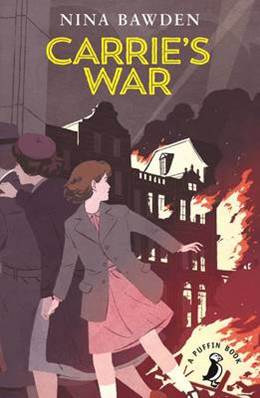
As a teenager, I remember reading two terrific novels about young evacuees during World War II. Carrie’s War by Nina Bawden, is a beautifully created, semi-autobiographical tale of a brother and sister sent away to a run-down Welsh mining town to escape from the air raids over London. The evacuation, while not the story’s primary focus, provides the incentive to move the protagonists to an unfamiliar setting without their parents, in order to describe a poignant coming-of-age drama, far from the safety and familiarity of home.
Popular children’s author, Michelle Magorian, has written several novels about the war and evacuees, including Goodnight Mister Tom, A Little Love Song and Back Home. The latter remains my favourite, although it can be quite heart-rending. Twelve-year-old Virginia, known as ‘Rusty’ because of her auburn hair, returns to the harsh reality of post-war Britain after spending the war years safely in America. The culture shock, the homesickness for her American childhood and family and the difficulty of reconnecting with her ‘real’ family were no doubt common emotions for those children sent abroad for the war.
I loved these books, and they really gave me food for thought at a young age. What was it like to be sent away from your family, with no notion of where you were going, with whom you’d be living and when – or if – you would ever see your parents again? Can you imagine being those young kids, so far from home, who may never have seen a farm, a field or a cow in their lives? Huddled in a village hall, tired and confused, carrying only their gas masks and the bare minimum of clothes in cardboard cases, they would wait to be selected by their unknown host families. Everything was labelled, including the children themselves, to reduce the chances of losing anything or anyone. Remember Paddington Bear, turning up at Paddington staion like a lost package? All those novels had relatively happy endings, but there must have been plenty of sad, misplaced childhoods among the hordes of evacuees forced to leave their parents, often for years.
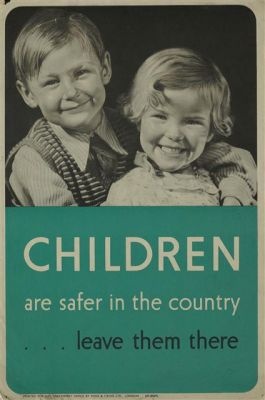
As early as 1938, the British government had put together a plan to move legions of people, mostly children, from areas at high risk of enemy air raids, to safer locations. And this complex scheme was put into action days before Prime Minister Neville Chamberlain declared war on September 3rd1939.
Operation Pied Piper would be the biggest population migration in British history. Thousands of children from wealthier families, some with their parents, many without, were rapidly exported to distant destinations such as Australia, America or South Africa. Hundreds of thousands more were moved from vulnerable cities and ports to towns and villages further inland, to board with strangers, many for the duration of the war. In total, about 1.5 million people were transported across the country and around the world, and all this was achieved in a breath-takingly short time.
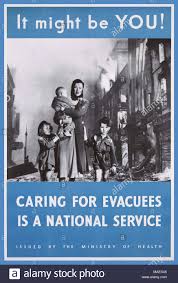
At the beginning of September, 1939 over 5,000 children were evacuated from Portsmouth to the Isle of Wight. Building bomb shelters, attaching blackout curtains and relocating all those mainland children became an overnight priority. For the duration of the ‘Phoney War’ (the first few months from September 1939 to January 1940) the powers that be considered the Isle of Wight a safety zone, unlikely to be vulnerable to enemy attack. This, even though Portsmouth and Southampton, barely ten miles across the Solent, housed huge dockyards and factories building battleships and Spitfires, all of which would become prime targets for the Luftwaffe. There was even ship building and aircraft factories as close as Cowes.
By Christmas, after none of the expected bombings or gas attacks, most of the evacuees returned home, only to be re-evacuated in June 1940, when the Germans invaded France. In the end, some 820,000 school children and their teachers would be evacuated, along with half a million mothers and children under five and around 12,000 pregnant women.
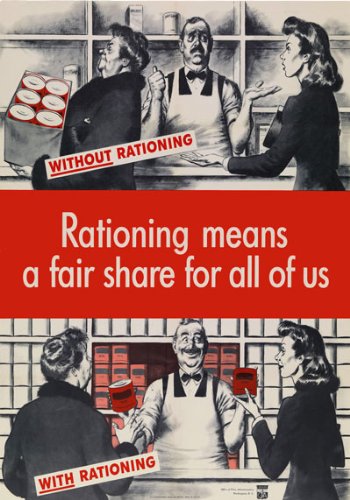
Rationing was another pre-arranged government incentive that was first introduced in 1940 – and here comes the interesting angle on food. Introduced by the Ministry of Food, rationing was a scheme to monopolize the sale of food in Britain, to ensure every citizen was adequately fed and that no one – particularly the wealthy – could hoard supplies while others ran short.
As an island, heavily reliant on imports, Britain became increasingly vulnerable to German submarine attacks on ships bringing food into the country. Slogans such as ‘be thankful and never grumble’ and ‘never leave any food on your plate’ were pasted up everywhere, but didn’t do much to fill grumbling stomachs.
As soon as war was declared, every householder had to provide details of all the people living under his or her roof. Every person on that form was then given an identity card and a ration book. These books contained coupons that had to be signed or stamped by the shopkeeper each time rationed goods were bought, to ensure that people received only the specified allowance. ‘Retail Price Maintenance’ (RPM) was an essential part of the Government’s rationing policy, a practice which continued until the 1960s. The Ministry of Food also introduced unrationed school dinners in 1941, to ensure every child got at least one nutritious meal a day.

Initially, rationing only involved bacon, butter and sugar. By June, the list included jam, cheese, tea, margarine and eggs. Six months later, rice, dried fruit, tinned tomatoes and peas were added, and by the end of summer 1942, sweets, chocolate and biscuits were being rationed too. I couldn’t find specific figures for children, but an adult allowance included one egg per week, 4oz bacon or ham, 2oz margarine, 2oz tea, and 2oz cheese. Butter was saved for pregnant and nursing women, and children under five. Only bread, potatoes, and other home-grown vegetables were not rationed, although of course these were only available in season. Pamphlets about the modest spud provided recipes for cakes and bread made with potatoes and a whole meal made by filling a baked potato.
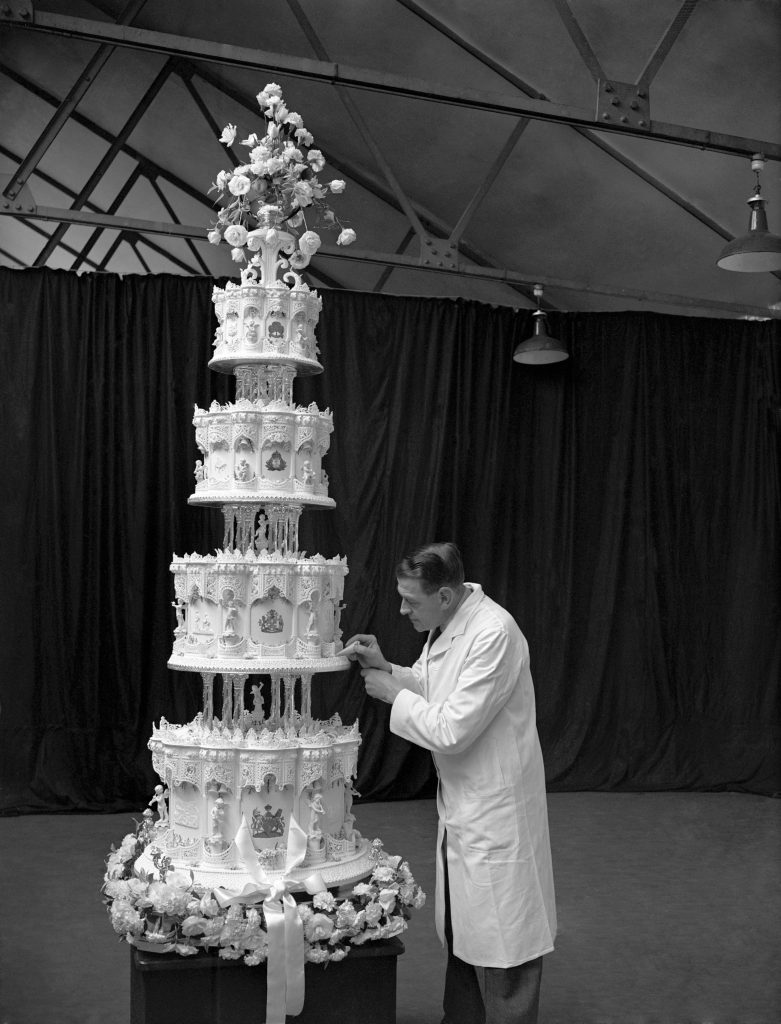
These restrictions were not fully lifted until 4 July 1954 – almost ten years after the war had ended. The campaign to be careful and creative with the food available included many a dubious recipe designed to help ‘thrifty’ housewives feed their families with a severely limited pantry. Scrimping and saving became a way of life for decades. In 1947, for the royal wedding of the Princess Elizabeth and Prince Philip, ingredients were sent from all over the world for the wedding cake, including sugar from the Australian Girl Guides, as rationing was still in place in the UK. Apparently hundreds of people from across the UK even sent their clothing coupons to the princess to help with her wedding dress, although these had to be returned, as it would have been illegal to use them. It was, perhaps, an overtly extravagant cake at such a time – but perhaps it also provided a lacklustre, exhausted country with a symbol of hope for the future.
It is increasingly hard to imagine such a time of frugality and scarcity in this era of over-abundance, when supermarkets are full of never-ending food supplies from all over the globe in all seasons. But it is perhaps a timely reminder that we can survive on far less than we may believe possible.
*All photos and images care of Google images, with thanks.








 There is something mystical, magical and utterly captivating about an island. Particularly a small one like the Isle of Wight. Acquiescent in its geographical limits, yet baffling in its sense of ‘otherness,’ its sense of isolation from a more consequential mainland.
 the hills below the Downs. It is early spring, and the formal gardens are looking sparse, but will come into their own later in the year. These gardens have been redesigned using plants common to the Mediterranean and drier areas of the southern hemisphere, to ensure less water is needed to maintain them. This not only came about because a previous lady of the manor was Sicilian, but because the Isle of Wight is not self-sufficient during summer, and must bring water from the mainland, through pipes beneath the Solent.
 Further up the valley, we discover woodlands on the cusp of bursting into a full-throated chorus of bluebells. We plan to come back in a week or two to see them at full throttle. Leaving the woods through a kissing gate, we follow a steep, sunken path uphill. As the path emerges onto Castle Hill, we are confronted by a pair of ancient stones: a megalithic standing stone or menhir made from local sandstone four metres high, with a smaller one lying at its foot. It is said thy were dislodged by the Saxons and, later moved by a nineteenth century squire, so that today they no longer stand where they are thought to have been originally planted: at the entrance to a nearby Neolithic burial ground, or possibly as part of a druid temple. The National Trust website suggests that ‘moot’ is Saxon for meeting, and it seems probable that the menhir provided a meeting point for the Saxons, and that Mottistone is a corruption of Moot Stone.
 Yarmouth, is the old railway station. Once part of the island rail network, the station first opened in July 1889. Unfortunately, like many other lines on the Isle of Wight, the Freshwater-Yarmouth-Newport railway, was never a financial success, and it finally closed down in 1953. For fifty years the station building housed the Yarmouth Youth Club. It was sold in 2010, when the original building was carefully renovated and decorated with a railway theme. It opened as a restaurant in 2014. The aptly named ‘Off the Rails’ now provides sustenance to walkers, cyclists, holidaymakers and locals who pass along the disused railway track that is now a path along the Yar to Freshwater.
 menus for breakfast, lunch and dinner with many nods to this railway themed diner: a Controller’s Chowder loaded with seafood; the Yardmaster’s fabulous carbonara with pork belly and freshly made pasta served up in a wooden bowl; Firebox fishcakes, moist and fresh and rolled in charcoaled coconut crumbs to resemble coal; a Trackside fish’n’chip butty, and Furnace, a smoked mackerel bruschetta, to name but a few. Anything take your fancy? Till now, I have only popped in for lunch, but if the rest is as good as the meals we have sampled, no one will suffer from a lack of tasty offerings. I also like the fact that the kitchen does not cater to the usual notion of a kids menu full of fried food and carbs but simply provides smaller samples of the adult menu.