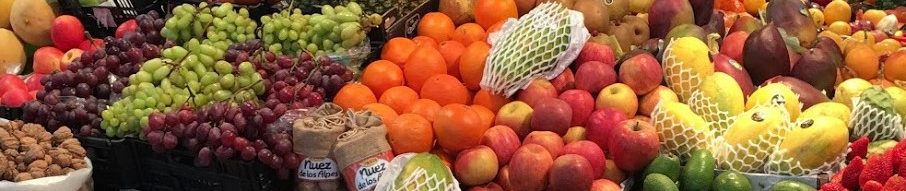
For a couple of days, it was like having jetlag. Dinner at 9 o’clock meant bed after midnight, breakfast at about 10am and lunch between 2-3pm. And, of course, a siesta afterwards. After only a couple of days, I got the hang of it, and even while travelling on my own, I find I have adapted rather well to Spanish time. And eating in Spain has been a joy. The pica pica style of dining has suited me perfectly, especially as September has proved to be almost as hot as August. Who honestly wants a big meal on a blazingly hot day, anyway?
I flew into Madrid where I had booked a hotel room just for one night. Or so I thought. Instead, it was a shared, rather rundown apartment, where the bed was made for Goldilocks and there was no room to swing a hamster. There was also no lock on the door. All for some ridiculously exorbitant sum. Fortunately, a Spanish friend was in town for the week and came to my rescue. Having exchanged horrified glances, we promptly departed and moved my suitcase to her spare room. We then headed out to explore her side of town.
I do love seeing a city through the eyes of someone who lives there, rather than through a tourist brochure, especially when they love it as much as she does. We wandered along the western edge of the city to watch the sun set near the Temple of Debod. This glorious temple was originally built on the banks of the Nile in about 200 BC and dedicated to the Egyptian gods Amun and Isis. It was gifted to Spain in the 1960s by the Egyptian government; a ‘thank you’ to the Spanish for helping to rescue the ancient Abu Simbel temples that would otherwise have been flooded during the building of the Aswan Dam. Debod Temple was deconstructed and transported to Madrid, where it was rebuilt at its current location at Cuartel de la Montaña Park. Here, surrounded by water and overlooking the city, this Egyptian Temple is particularly lovely at sunset. Later, the illuminations give it a mystic quality and make it a favourite place for locals to stroll after dinner.
We dined well at a café with the grandiose name of Palacete de Rosales, on a tree-lined terrace overlooking the park, and finished up with a gelato on our walk home. The following morning, I regretfully departed after all too brief a visit, to catch the train south. But, comfortably seated and airconditioned, I was happy to watch the countryside flash by: four hours of scenery that looked as sunburnt as South Australia at the end of summer, and with a similar dearth of trees, but with decidedly different architecture.
By mid-afternoon, I had arrived in Jerez de la Frontera, a small city between Sevilla and Cadiz. The old quarter contains the Alcázar de Jerez, a fortress built by the Moors in the 11th century. The famous Royal Andalusian School of Equestrian Art will sadly have to be saved for next time, and although I also went without a trip to one of the bodegas (where sherry is made), I did not stint on imbibing it. Three nights with old friends passed rapidly, drinking way too much oloroso sherry and – like mad dogs and Englishmen – going out into the midday sun to explore the city.
Spanish parks bear absolutely no resemblance to British ones, so I found little in the way of tree cover or lawn, but only a lot of packed sand and ranks of palm trees providing barely a splash of shade. Gasping with heat and dehydration, I fell into Bar Filipino on the far side of Parque González Hontoria for a bowl of pancit and prawns, delighted to be served by a young Filipina, born and raised in Jerez, but familiar with Luzon, and happy to trade stories. After some time quietly recuperating under a beach umbrella, nibbling noodles and devouring two icy cold Cokes, I felt fit enough to regroup and continue my journey into the centre of Jerez. There I found a gelateria, which by fluke, turned out to be the best one in town, and provided me with the burst of energy required to walk home. Flavour? Pistachio – always – and mango.
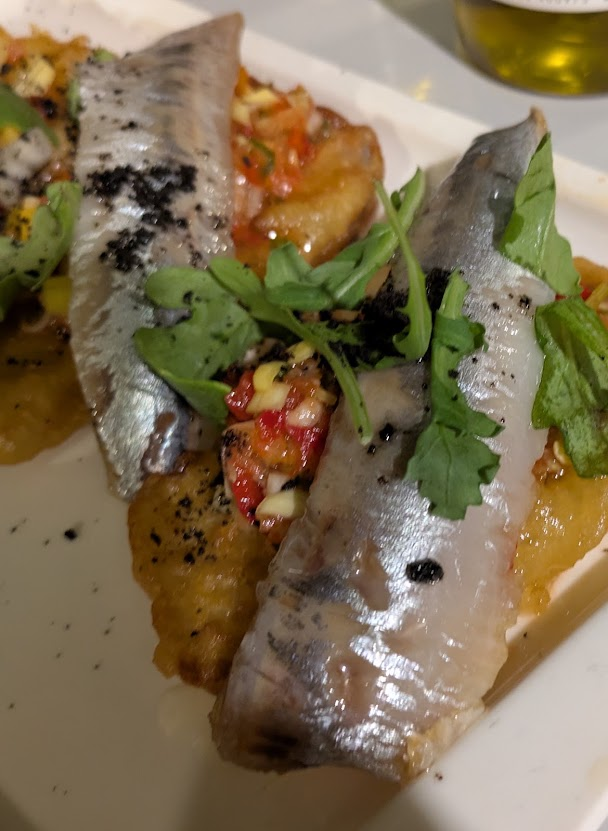
As in Madrid, I also got to see this southern city through the eyes of a native jerezana and her British husband, who proved to be more addicted to Andalusia even than she. The days flew by, largely marked by good food, sherry and regular siestas. The local taverna is literally a stone’s throw from my friends’ apartment, and, like the Spanish version of “Cheers”, everybody knows your name. Another night we walked into the centre of town to a beautiful little plaza for dinner at La Cruz Blanca (the white cross). There we ordered some truly excellent tapas, including the best pulpo a la gallega I have ever eaten. It literally melted in your mouth. The prawn fritters were pretty good too, and we finished by sharing a rather scrumptious Spanish version of bread pudding: toijas de leche. We also spent an evening down on the coast at Valdelagrana, in search of a cooling sea breeze, and a light supper. This popular seaside resort is tucked between the Los Toruños Natural Park – a preservation area of coastal wetlands – and the Bay of Cadiz, whose lights after sunset reflected on the sea. We strolled along the promenade and I dipped my toes into the chilly waters of the Atlantic Ocean. We finished up with gelati and/or a shot of limoncello on ice.
Before I outstayed my welcome, I hopped on a bus to Ronda, one of the many ‘white hilltop towns’ of Andalucia, which – not surprisingly – involved some sick-making, serpentine roads. Ronda is a popular town for day trippers, and by lunchtime, the main streets are tsunamis of tourists, so that I found myself ducking down side streets to find some peace and quiet at the more down-to-earth, local cafes. I stayed for five glorious days, but must write a separate blog for that part of the trip.
Returning briefly to Jerez, I popped my nose into the Mercado Central de Abastos (which I read as ‘Asbestos’) and Alcázar de Jerez de la Frontera (or ‘Alcatraz’ if you are either dyslexic, or blurry eyed with the heat). As it was a Monday, half the market was closed as the fishermen don’t go out on Sunday. But the 12th century Alcázar was a splendid alternative, and provided some super views of the city from its walls. Originally the seat of power for local Muslim rulers, it was eventually besieged and conquered by the Castilians, and 500 years later, a baroque palace was built within the walls.
On my final night in town, we dined again at the neighbourhood taverna, where I learned the lovely phrase “my English is not very good looking.” Apparently, the world famous Afro-Latina singer Celia Cruz often used this phrase tongue-in-cheek during her concerts, and it has since become a bit of a meme internationally. As I knew neither the phrase nor the performer, I did some quick homework with Google. So, for those of you who might not have heard of her either, Celia Cruz was known as the Queen of Salsa, with her strong, operatic voice, exhilarating stage presence, and pivotal role in popularizing Afro-Cuban music around the world. Sadly, she died in 2003, but I am off to find some recordings, for I can’t help but admire a woman who comes up with such a fabulous description of her poor English, and assume her music must be fairly good looking too!
Much to my chagrin, however, my Spanish, like Cruz’s English, is also not very good looking. I have solo un poco de español, and when I can’t find the word I want in Spanish, I am apt to lapse into German, French or Italian. Well, at least I’m not shouting to make myself understood! And after almost a fortnight here, I realize I have acquired a lot of vocabulary for food.
So, I am now in Sevilla for a final two nights before flying on to meet the One & Only in Porto. Spain has provided a varied and very tasty fortnight, but tonight, I am going to break with tradition and try out a Lebanese restaurant, Fatouch, only seven minutes’ walk from my apartment, that came highly recommended…
… which not only provided a delicious meal but some of the friendliest staff I have come across, and a very sweet dinner companion. Seated side by side at the bar, Angela and I started chatting, as she helped me translate the Spanish-Lebanese menu. We ended up sharing a ‘Hummus Rosa’ (made pink with beetroot and topped with a sprinkling of cashews) and a dish of diced garlic potatoes. I accepted her recommendation of the delicious kofta and downed two glasses of the most wonderfully refreshing homemade lemonade ever. Then she kindly provided me with a spontaneous and very thorough tour of Seville by night. On foot. We walked and talked till our tongues were stilled by our very tired feet, but what a wonderful way to see this ancient city. Last time I visited, I was hobbling on a bad hip, this time it was only some 10,000 steps that finally drove me to home to bed. We passed the Alcatraz and the cathedral and any number of other stunning churches. We strolled along the riverbank, and she gave me some tips for the following day.
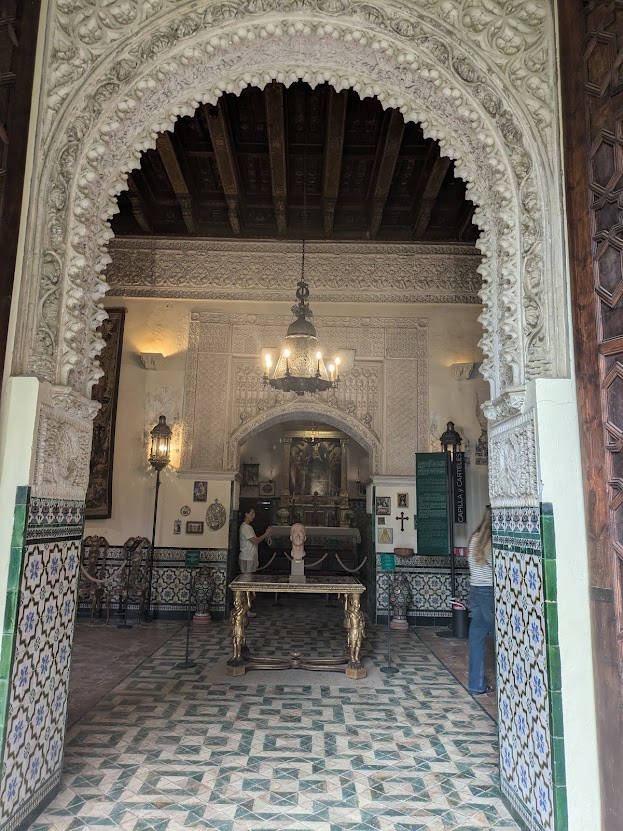
Unfortunately, I was never going to find time for them all, but early this morning (early for Spain) I wended my way to the Palacio de las Dueñas, which Angela had pointed out last night as the birthplace of the Spanish poet Antonio Machado. This sumptuous palace takes its name from the old Cistercian convent of Las Dueñas, whose nuns served the queens and wives of the kings of Castile, but it has belonged to the noble House of Alba since 1612. The top floor is still a private residence, but visitors are welcome to wander everywhere else.
I could not have asked for a better way to spend the morning and was blown away by the architecture and artwork hidden away behind high brick walls in this quiet nook of Sevilla. Built in the late 15th century, it mixes the Renaissance with Gothic and Moorish influences, and the grounds are a series of walled courtyards filled with exotic plants, pottery and paintings. Meanwhile every room is a museum of architecture, art & the ubiquitous ceramic tiling, introduced to the Iberian Peninsula in the 8th century by The Moors, following their invasion in 711 AD.
I could almost write an entire blog about this amazing place, but I have chatted long enough and must depart to find some lunch. “What eating again?” You may well ask. But what else should one do in Spain?