
Phase 2 of the Salt Path Experience: Minehead to Lynmouth
We have moved on to Somerset this week, but only fleetingly. The walk, as I think I mentioned before, officially begins in Minehead. So we have spent two nights in Porlock, which has a lovely but extremely narrow high street, where I have been playing a dangerous game of dodgems with other drivers, and attempting not to career through the shop windows. I’m sure within a week, I will find myself craving the elbow room of the wide streets and ample parking in Normanville, but so far it has just made me smile. A lot.
Today I am heading south into Devon, to meet the One & Only in Lynton & Lynmouth, a bizarrely situated twin town, where one town is located at sea level, and the other sits atop the cliff above, with a ‘Cliff Railway’ between. But I’m not there yet, so we’ll save that for later…
…Coz I am currently sitting in The Old Library Café in Porlock – despite its name, it is remarkably bereft of books – and enjoying a mid-morning breakfast of mushrooms and spinach on sourdough, after packing up our darling little AirBNB cottage; the perfectly named “Hidden Cottage”. Tucked away at the end of a maze of narrow alleys, it took some finding. The hunt proved worth it for the treasure we found at this end-of-row, two-up-two-down cosy retreat, swathed in full blown roses. It also proved to be something of a Tardis: miniature on the outside, surprisingly roomy within, with a wood stove, two deep sofas, and a great country kitchen. Even the bathroom rates a mention with its beautiful claw-footed bath, a separate shower, and still enough room to hold a party – a far cry from so many English bathrooms which seem to have been squeezed into a wardrobe with barely room to pivot on a pin.
The beautiful Somerset sandstone, iron rich and almost Titian red, rules supreme in Porlock, where it is used for garden walls, churches and houses; giving off a warm and inviting autumnal glow. An after dinner stroll takes us along winding lanes and down hidden pathways, and we find ourselves quite enamoured of this pocket-sized village built for hobbits.
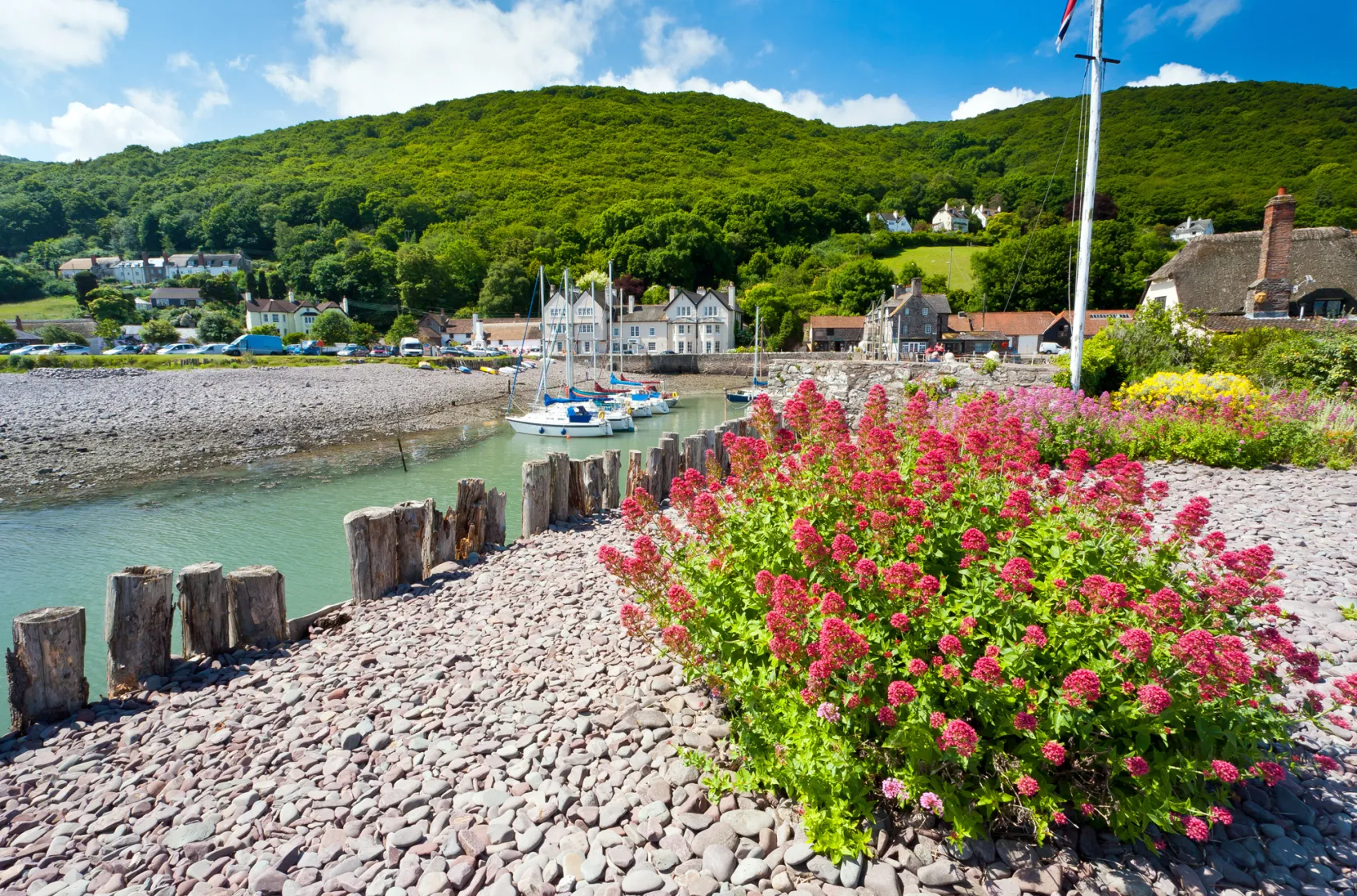
Meanwhile, only a couple of miles down the road, is Porlock Weir (above), where sign warns us to duck before entering the pub. And duck we do, or risk losing our heads!
Having just driven up Porlock Hill, I had to pause at the top – firstly to admire the view, secondly to describe to you the steepest hill I have ever ascended. At one point it felt as if the car were balancing on its back wheels – and as for the corkscrew bends. Apparently, the gradient is 1:4 which is the maximum steepness for roads. It feels as if a strong gust of wind would send the car somersaulting backwards down the hill.
Onwards and upwards we go, through bright green tunnels of beech, past the most neatly clipped beech and hawthorn hedges I have ever seen, and out onto moorland studded with yellow gorse that smells so invitingly of coconut – or pina colada if you prefer – and hawthorn sprinkled with white confetti blossom. It is spring, and the verges are stippled with campion and cow parsley, bluebells and buttercups.
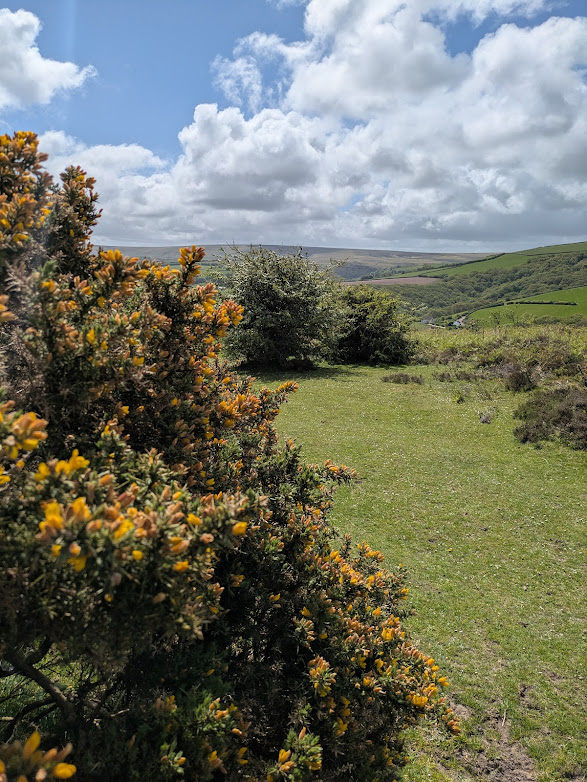
Now, I am parked just off the road overlooking densely wooded valleys to the east and turbulent, grey, white-capped seas to the west. Green fields on the far side of the valley are freckled with mouse-sized sheep. In the distance, the bare hills of Exmoor stretch as far as the eye can see. The wind is careering through the shrubbery and whipping around the car with a boisterous ferocity. I would take a stroll over the moor, but I suspect I would promptly be blown over the edge and up into the sky, like Mary Poppins.
Perhaps, while I am so warmly cocooned in the car, with such a superb landscape before me, I will take a moment to recap on yesterday’s journey from Weymouth, when we paused for morning tea and a picnic lunch at two conveniently placed National Trust properties.
In much the same way that England is dotted with sheep, it is also dotted with a profusion of wooden signposts indicating walking paths, and National Trust signs pointing the way to another castle, beach or stately home.
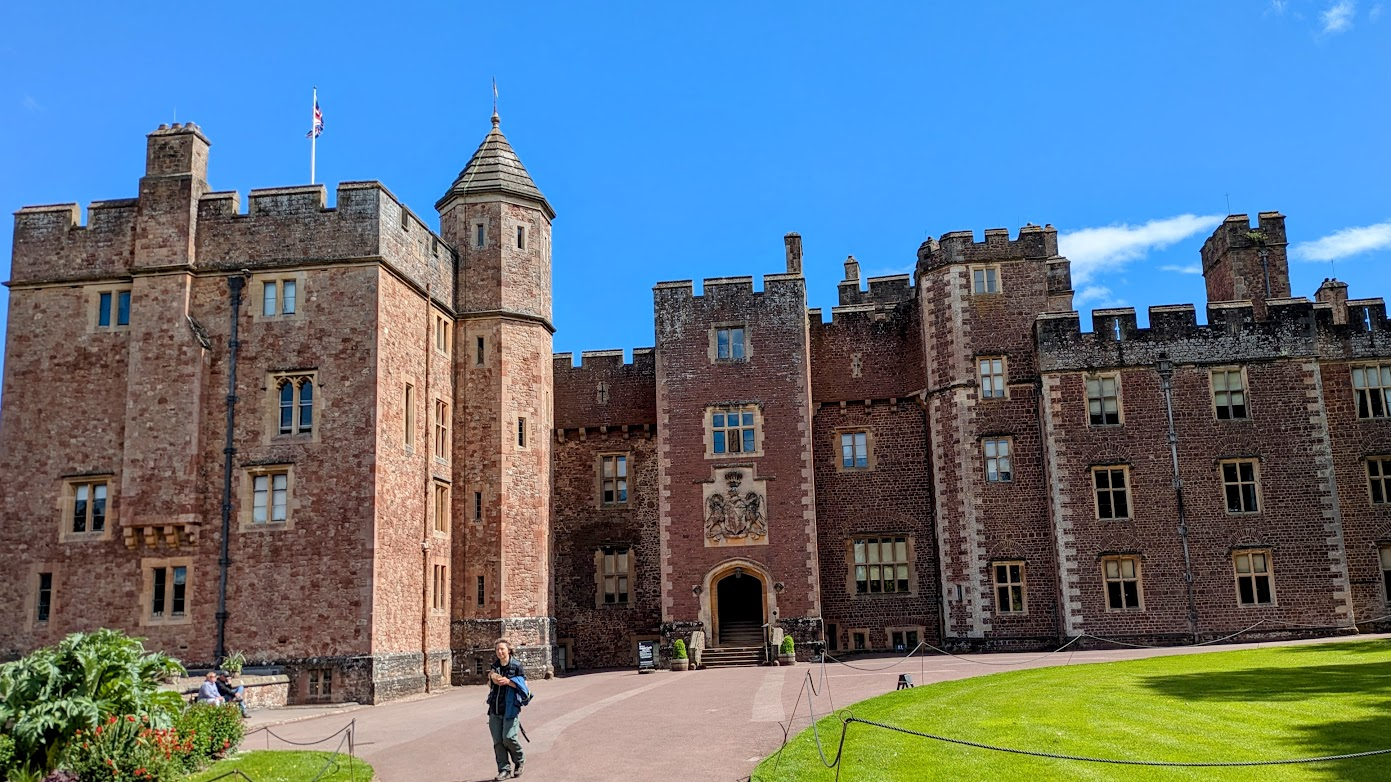
Yesterday, we did not even need a signpost, as Dunster Castle rose out of the trees ahead of us like something from a fairy tale. Apparently, this glorious stronghold has been commanding the best view of the coast and surrounding countryside for hundreds of years, and despite several attempts to destroy it, it has somehow stood its ground. Although Oliver Cromwell’s Parliamentarians had a good bash at toppling its 13th century curtain walls and bastions, reducing them to rubble in 1650. Thank heavens the house, the gatehouse and the mediaeval village below, were spared.
Ironically, the Luttrell family were originally Parliamentarians themselves, but after they were besieged by the Royalists – twice – they succumbed to arm twisting and swapped sides. As a reward for their gracious surrender, they were allowed to host the young Prince Charles (the future Charles II) while he attempted to rally support in the west. This, of course, did not go down so well with the Parliamentarians when they arrived in town.
The Luttrells had, by then, owned Dunster castle for almost two hundred and fifty years. And somehow, through all the vagaries of history – and spendthrift custodians – they held onto it for another three centuries. Timely marriages helped to refill depleted coffers, one in fact to an Australian heiress, Alys Luttrell (nee Bridges) who met Geoffrey Lutrell in Australia, when he was working for the Governor General. They were married in 1918, and moved back to Somerset and Dunster Castle. Sadly, an enormous bill for inheritance tax after the death of his father, Alexander, in 1944 meant that even Alys’s fortune could not save them. Geoffrey had to sell off the entire estate to pay the death duties, as did so many of his contemporaries after WWII. Ten years later, however, he somehow managed to buy back the castle and grounds, and the Luttrells continued to enjoy their family home for another twenty years.
Geoffrey, however, died three years later, and after Alys’ death in 1975, their son Walter passed the custodianship of Dunster Castle over to the National Trust. It must have been a sad day for the family, after so many generations of stewardship, but for the rest of us, it is a fabulous opportunity to explore a beautiful property in the heart of Somerset.
As we walked up the hill from the carpark, the local bellringers were practising their talents in the church tower and – something I have never heard before – were playing a hymn I recognized from my youth (although I can’t now remember what it was!) An NT guide later told me they had played nursery rhymes for a group of school children only last week.
Winding pathways crept up the side of the hill face to the South Terrace. Flower beds along the way were choc-a-bloc with native and exotic plants. We were delighted to discover the same variety of bottlebrush that grows in our own garden in South Australia. A Victorian conservatory links the library and the drawing room, and contains many sub-tropical ferns, vines and flowering plants. Apparently, Alys Luttrell played a huge part in adding variety to the grounds and gardens at Dunster and was known to have brought back many interesting plants and seeds from her world travels. We sat on the terrace, in the sunshine, befriended by a pair of very cheeky robins, and enjoyed our sandwiches, gazing out across the Severn Estuary to Cardiff. Or perhaps Port Talbot.
Dunster castle, once a hardy fortresss, has long been converted into a comfortable home, to the extent that the old Victorian kitchen has even been replaced with a 1950s turquoise horror. Historical in its own way, I guess, and undoubtedly more practical, but decidedly lacking in charm. In the entrance hall, a local volunteer regaled us with a medley of Lerner & Loewe songs on the grand piano. I found it totally irresistible not to sing along.
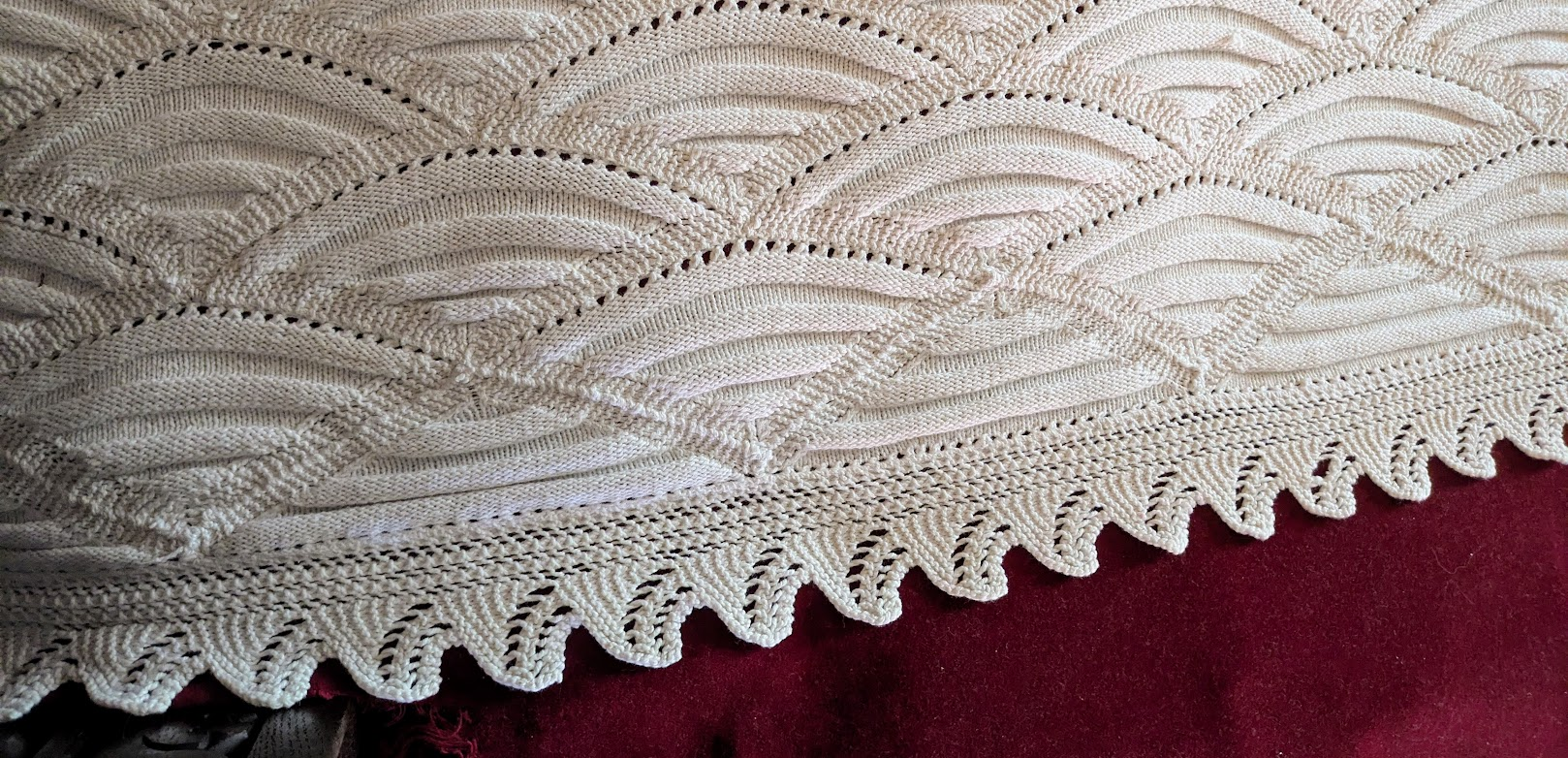
After exploring the house (some ‘interesting’ flocked wallpaper, hand quilted bedcovers and one quite exquisite covering that had been knitted from cream cotton, above) we took a turn around the grounds and found ourselves down at the water mill, which has been beautifully restored. Then it was back along the stream to the carpark and onwards to Minehead and Porlock…
But just to back track for a moment, to our morning tea pitstop at Montacute House. Again, we saw a National Trust sign and followed our noses down a behedged lane, and through the picturesque village of the same name. This handsome Elizabethan mansion stands proudly above the River Parrett, built by an ambitious courtier, Sir Edward Phelips. Phelips used the distinctive, honey-coloured local limestone to build his ostentatious ‘prodigy house’, which he topped up with stones recycled from the remains of a nearby priory, abandoned after Henry VIII seized all the wealth and assets of the Catholic Church in the sixteenth century. Phelips then installed enormous glass windows and added many European architectural touches, designed to exhibit his great wealth. Apparently, it is one of the finest Elizabethan houses of its kind left in England.
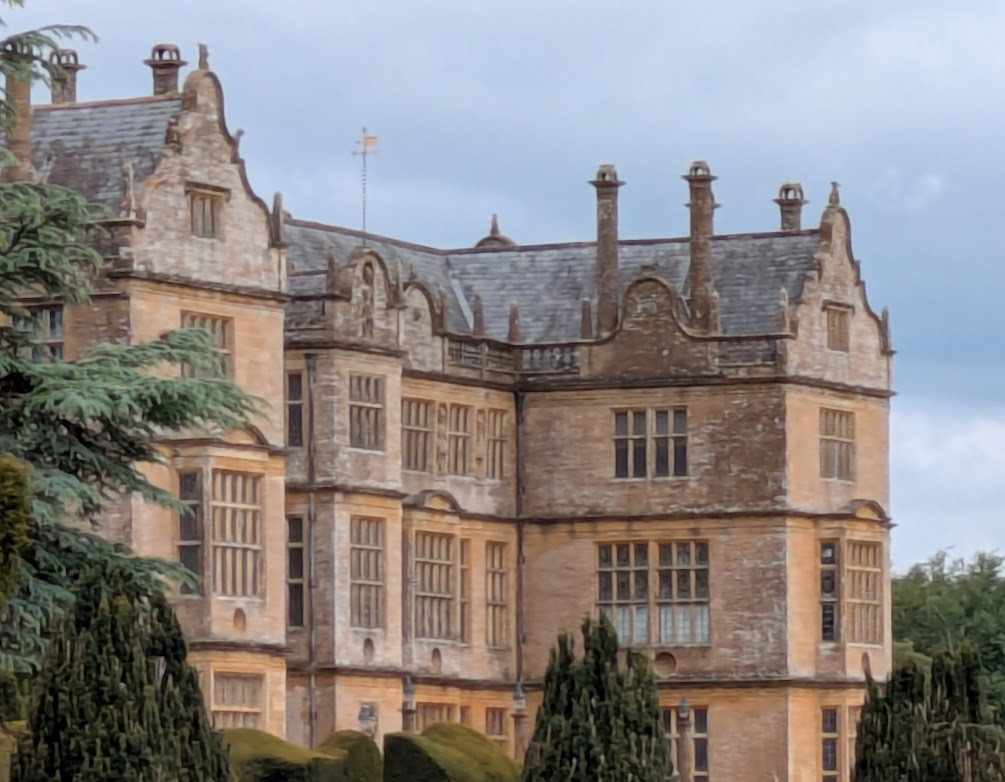
The house has long been a popular film setting for many an historic drama. You may recognize it from the 1995 film Sense and Sensibility where it played the Palmer’s country home, Cleveland House, or perhaps as Greenwich Palace in the BBC series Wolf Hall.
Pausing at the stable café for a mug of tea and a scone, we thought about joining a tour of the house, just as a bus load of tourists descended upon us. So, we promptly deserted that idea. Instead, we happily walked a lap of the surrounding parklands and chatted with a herd of beautiful young chestnut-coloured calves along the way, before heading on to the coast.
I only wish we had had a bit more time to explore. But then, to borrow from Tom Gleisner and Rob Sitch, there is always a National Trust sign somewhere…