
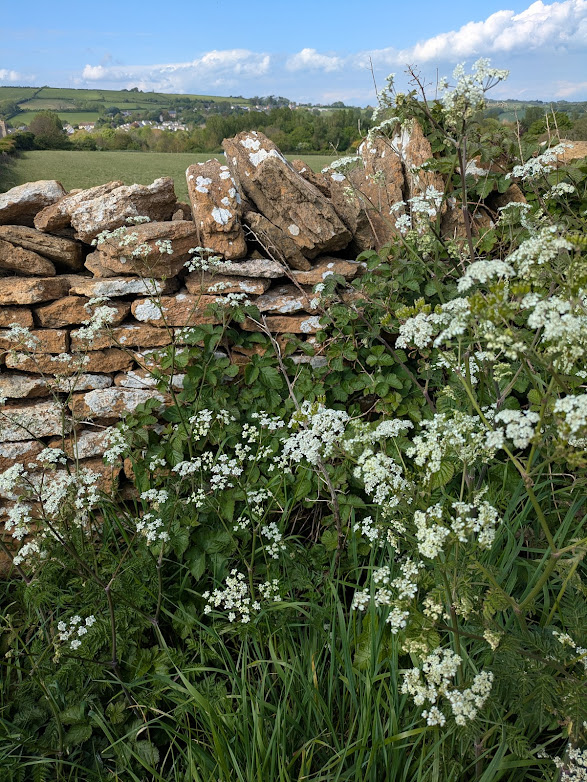
Lime Regis, where “the principal street [is] almost hurrying into the water, … [and] the very beautiful line of cliffs [are] stretching out to the east of the town.” ~ Jane Austen, Persuasion
Phase 1 of the Salt Path Experience: Lyme Regis to Poole Harbour
The One & Only is off to walk the Southwest Coastal Path, aka the Salt Path. This challenging, long-distance trek follows the coastline from Minehead in Somerset, through Devon and Cornwall, to Poole Harbour in Dorset for over 1000 kms (630 miles) of glorious coastline that includes windswept cliffs and pebbled beaches, fishing villages and remote farmhouses, sea pinks and sea kale, huge gulls and Mute Swans, and a smattering of woodland. The entire walk takes 7-8 weeks to complete. As the One & Only trudges up hill and down dale, communing with nature, I will trail along in the car to fetch and carry. It saves him having to carry kilos of camping gear and it is giving me a wonderful chance to explore the blissful Dorset countryside without having to suffer a single blister!
The SW Coastal Path became a national walking trail in 1978, and had earned a reputation as the longest, most challenging long-distance hike in England. That changed, however, when King Charles inaugurated a new coastal trail in March. Although it is still under construction, the King Charles III Coastal path will eventually wrap around the English coast for over 4,000km. The new trail incorporates several established coast paths, including the SW Coastal Path, with the optional addition of the Wales Coast Path.
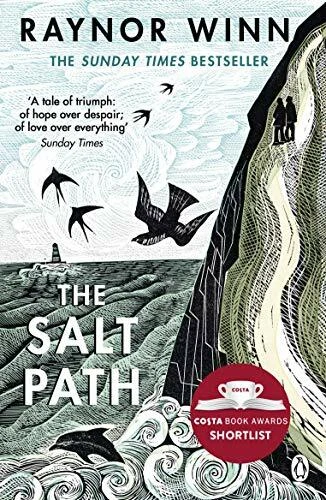
The SW Coastal Path has received considerable attention over the years, from seasoned walkers, travel writers and bloggers. Most recently, Raynor Winn’s memoir, “The Salt Path,” published in 2018, has inspired a new generation of ramblers, and been nominated for several awards. “The Salt Path” is the tale of a life-changing journey along the SW Coast Path, after Winn’s husband had been diagnosed with an incurable disease and they had lost their home. The book even spawned a movie, released in the UK in May last year, which starred Gillian Anderson and Jason Isaacs.
Since then, a journalist at the Observer has questioned the veracity of Winn’s story, and accused her of being disingenuous. While Winn has denied the accusations, it seems they are hard to refute. Yet, despite the scandal, the book has continued to sell. And even if she did fictionalize some of the story, this ‘novel’ about resilience, love and self-discovery has sold well over a million copies. Reviews have been mixed, so I will leave it to you to decide if it was worthy of all the attention!
In the meantime, I am sitting over a cooling coffee at the bottom of Broadstreet – that principal street in Lyme Regis that does indeed seem to nosedive into the sea. As I look out over the English Channel, the marina and the Cobb, I feel very close to Jane Austen this morning, who first came here for a holiday with her sister Cassandra over two hundred years ago. Lyme Regis became a popular seaside resort in the early nineteenth century, and, like multitudes of summer visitors before and since, Miss Austen was immediately enamoured with the charms of ‘this pleasant little bay.’ The town went on to play a significant role in her final novel, Persuasion, in which Anne Elliot reconnects with her past love, Captain Frederick Wentworth. Oddly, this is also a novel about second chances and self-discovery, although arguably rather better written. Not surprisingly, it has become something of a mecca for Austen enthusiasts.
Today, at this early hour, the sea is steely grey and there is a bracing breeze that sends me scuttling into a friendly pub for my first cup of coffee. By the time I emerge, the sky has cleared and is only lightly whitewashed in cloud. Crossing the car park at the foot of Broad Street’s steep descent, I meander onto a truly English seaside scene. The sun and the day trippers have emerged, and an array of deck chairs add a splash of color to the pebbled beach in front of a busy kiosk. A multitude of masts are clustered in the marina, the Cobb curving around behind them. This 13th century harbour wall has become a famous landmark, starring in several versions of Persuasion and also in The French Lieutenant’s Woman, with Meryl Streep. More importantly, it provides crucial protection from storms.
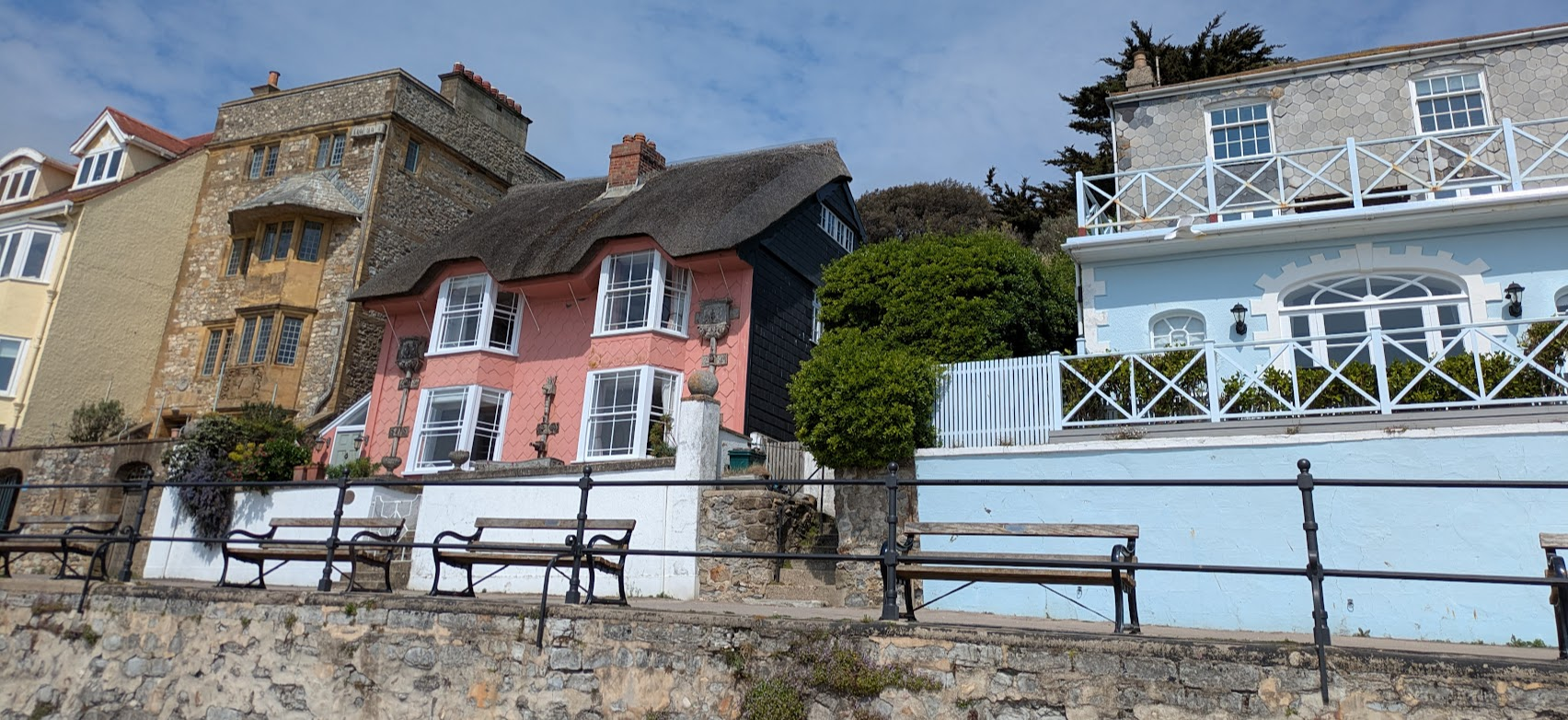
Along the promenade above the beach, I wander past an eclectic collection of cottages, guest houses and cafes. With a nod to Jane Austen, two matching cottages bear the names Harville and Benwick. Almost everyone I pass is bearing an ice-cream cone and the scent of chips doused in malt vinegar wafts past my nose. I don’t make it quite as far as the Cobb, as I have no desire to imitate Lousia Musgrove by leaping precipitately from the steps to be ‘taken up lifeless!’ Instead, I climb the steps from the beach, past several of those unnervingly enormous English seagulls – closely related to the albatross – that shriek rudely at passersby while others swoop overhead, surveying the beach for treats. Tucked up against the retaining wall, a tidy line of white bathing huts with pretty pastel-coloured doors gaze out to sea.
But it is time to move on. I am aiming to meet the One and Only further down the coast, and have read about a rather nice café where I plan to get some lunch.
Protected by the National Trust, Hive Beach is a picturesque shingle beach at the western end of the famed Chesil Beach. Encircled by golden sandstone cliffs that provide stunning panoramic views along the Jurassic Coast, it is a World Heritage Site, and home to the popular Hive Beach Café.
As I pull into the car park, I notice the sea is now a sparkling blue, an obstreperous breeze fluttering across the waves. Tucked behind the pretty stone village of Burton Bradstock, Hive Beach is sprinkled with dog walkers, hikers and young families. The Café, perched above the shingle, is sheltered from the wind and I find a sunny table looking out to sea. Fish and seafood are obviously prominent on the menu, much of it caught locally. How do you fancy a chilli and anchovy linguine? Or an entire West Bay Lobster? More modestly, I opt for a a crab tart, topped with a bird’s nest of rocket, orange and pinenuts. I can’t remember eating an English crab since we were living on the isle of Wight several years ago, but it is every bit as tasty as I remember. And what else to drink in Dorset but a half pint of cider? As it will be a while before the One & Only arrives, I take my time, and, after a short intermission, I take on a pot of tea and a scone to finish.
Afterwards, a siesta in the sun, lying on soft, spongy grass dotted with buttercups, halfway up the cliff.
Dorset is renowned for its Jurassic coastline, the sandstone cliffs brimming with fossils. Stretching 95 miles (154 km) from Orcombe Point in East Devon to Old Harry Rocks near Swanage in East Dorset, it is England’s only natural UNESCO World Heritage Site, designated in 2001 for its geological features and its famlous fossils. Highlights include Chesil Beach, the Isle of Portland, Lyme Regis, and the aforementioned Old Harry Rocks.
This stretch of the southern coast is largely rural, and gloriously green in May, and the fields brim with young calves and lambs.
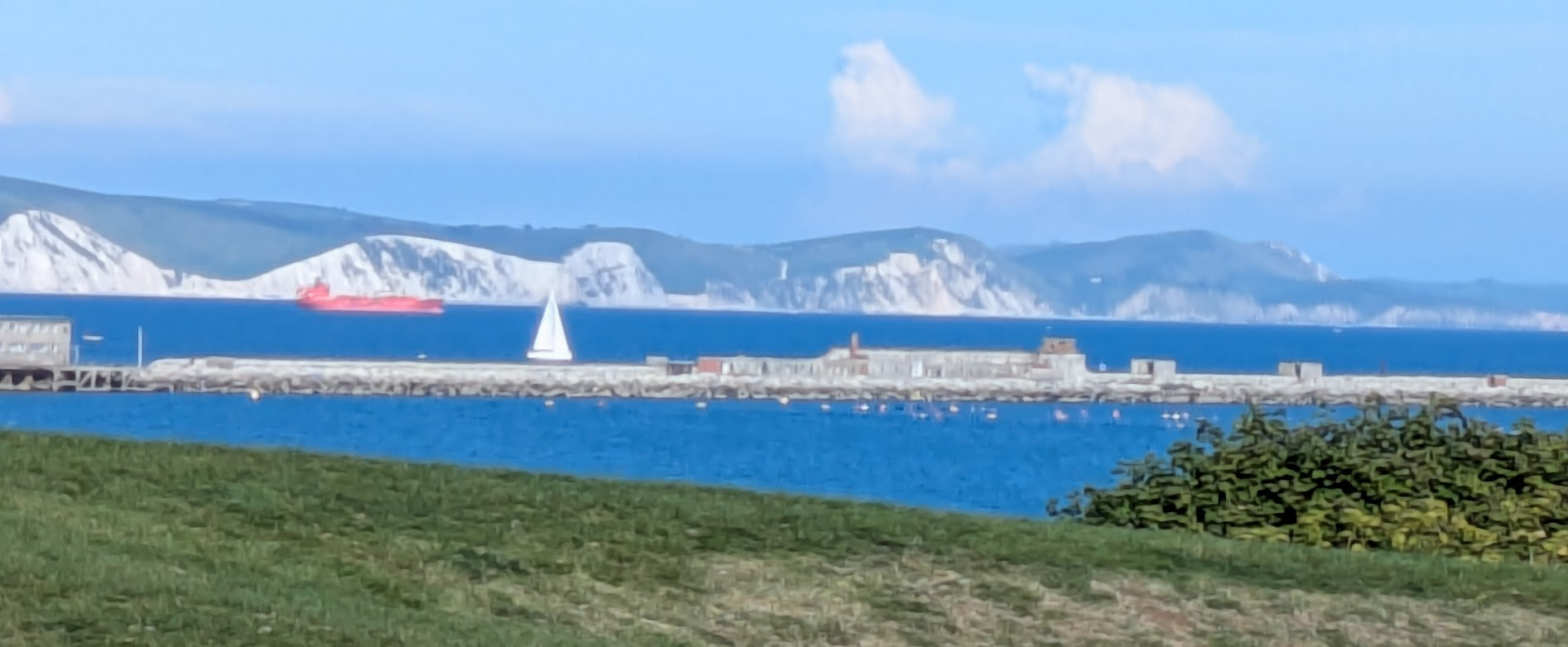
On this first lap of the walk, we are staying at Wyke Regis, tucked into the eastern end of Chesil Beach, just across the causeway from the Isle of Portland. Each day, I drop the One and Only at his starting point and collect him later from the finishing point. Previously, he has walked the Salt Path in fits and starts, so this month he is planning to fill in the gaps. Sometimes he walks east to west, sometimes it is more convenient to go west to east. On day one, he walks around the edge of the Isle of Purbeck, and finishes at the official end of the walk, which is marked by a metal sculpture near the Sandbanks Ferry terminal on South Haven Point, opposite Brownsea Island. The surrounding landscape is low lying, coastal scrub, but he says the last few miles from Swanage have included a stiff climb up Studland Hill, and a wonderful view over the Old Harry Rocks. These three chalk formations stand in the sea, once part of a long chalk band that stretched between Purbeck and the Isle of Wight, which have since been eroded by the sea. Now only three stumps remain at Handfast Point, gazing across the water to three matching chalk stacks – known as the Needles – on the western end of the Isle of Wight, which we once circumnavigated in a RIB (Rigid Inflatable Boat).
By the weekend, I finally shake off a persistent cold and wander down to Chesil Beach. The Visitors Centre is only a 10-minute walk from our front door, where there is an excellent exhibition explaining the geological history and the particular wildlife you can see along this extraordinary stretch of coast. Chesil Beach is 18 miles (30 kms) of shingle; the pebbles naturally graded in size from new potatoes at the Portland end to pea-sized at Bridport. The map shows an inner tidal lagoon – the Fleet – protected from the sea by a natural barrage of billions of pebbles. It resembles the Coorong in South Australia, albeit on a smaller scale, and like the Coorong, it is renowned for exceptional fishing and bird watching – although the strong undertow and the steep drop into the sea make for dangerous swimming conditions. That’s OK, as I’ve no inclination to even dip my toes! I am happy, however, to lie out of the wind, and find my stony bed surprisingly comfortable. For a while, at least.
To the south, the Isle of Portland rises out of the sea like an enormous whale heading out into the Channel. Dotted with quarries that are still in use, the island is renowned for its white Portland stone, a famous limestone that has been quarried since Roman times. More recently, it was used to build St Paul’s Cathedral, Buckingham Palace and the United Nations Headquarters in New York.
On the eastern side of the island, Portland Harbour is protected by Chesil Beach on one side and a vast stone breakwater on the other, built from Portland stone between 1848 and 1905, which makes it one of the world’s largest man-made harbours.
With only one road across the causeway between Fortuneswell and Wkye Regis, the rush hour traffic can be surprisingly heavy, as many of the 13,000 inhabitants commute to the mainland. Out on the southern tip of the island, a tall lighthouse overlooks Pulpit Rock, an unstable-looking rock formation that appears to balance precariously off the edge of the island. While the scenery is rather stark and severe and this exposed spot might be daunting on a blustery day, today the sea is calm, the breeze is gentle and the outlook is softened by patches of sea pinks tucked into the rocks.
And that’s probably enough for you to be going on with, so I will bid you farewell, until we meet again in Somerset, where the One and Only is off to find the very beginning of the Salt Path at Minehead.