As we start our descent over Kent, it is obvious that England has been scalded by summer sun this year and the countryside below is looking remarkably like Australia, the lawns and fields burnt to a yellowy-beige stubble. Heading east from Gatwick, the windscreen is deluged in much-needed rain, but without its usual lush green summer coat, the world simply looks bedraggled. Through pouring rain and traffic jams and the Dartford tunnel, we eventually emerge into Essex, where the cloudburst has cleared and the sky boasts a few patches of exuberant blue.
Essex is a low-lying county to the east of London, with an extensive stretch of coastline that is exceptionally tidal – mud flats and salt marsh are regularly submerged in sea from the English Channel that races up the Thames estuary at high tide and drops 4.5 meters (or 14 feet) at low tide.
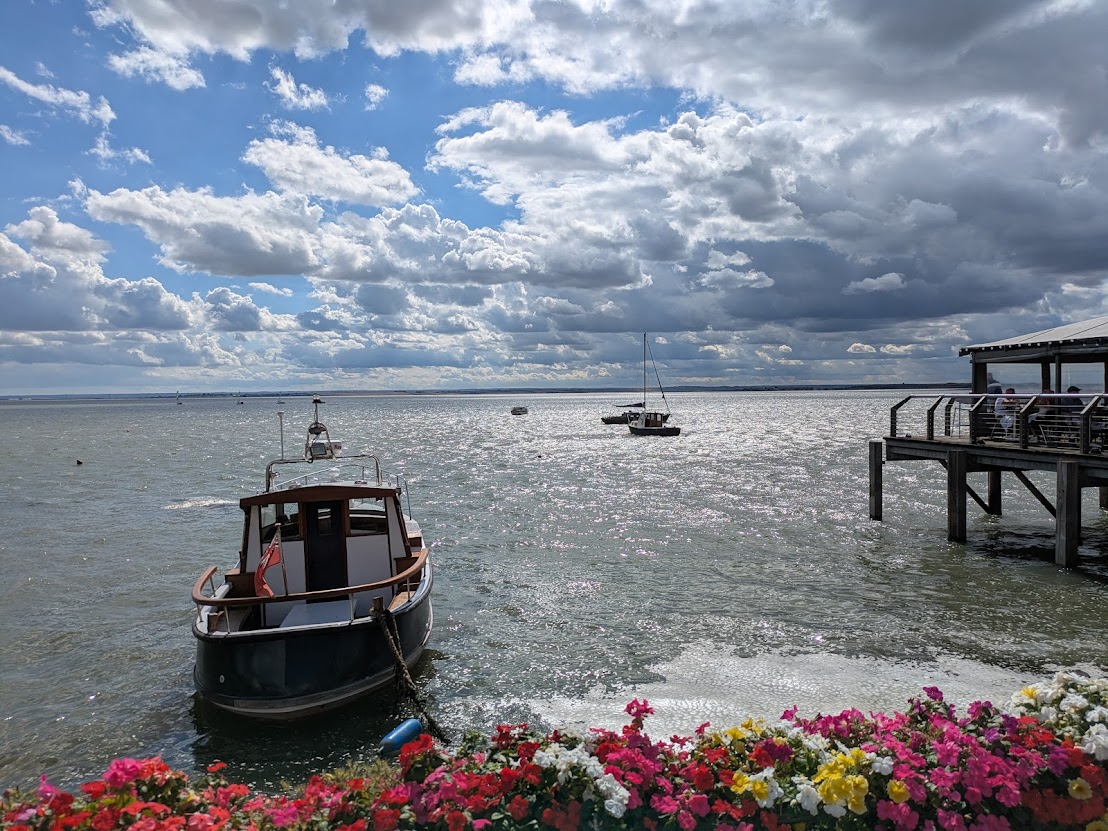
It is the last Bank Holiday Monday of the year, possibly the last day of summer, and the sky has transformed from gunmetal grey to a pale azure blue. We are strolling west along the coastal path towards Canvey Island and Hadleigh Castle, a medieval ruin once built by Edward III to protect England during the Hundred Years War. Behind us, the world’s longest jetty at Southend-on-Sea stretches almost a mile and a half out across the sand to the deeper water of the Thames, to play tippy-go with the ships that are heading into the London Docks. On shore, Adventure Island hails us with the shrieks and screams of the kids on the hair-raising rides that swoop and spin, while the Ferris wheel turns ponderously, smiling indulgently upon its wayward guests.
At Leigh-on-Sea, a cobbled street runs between the river and the train line, the c2c – or city to coast – that takes commuters from Shoeburyness to Fenchurch Street Station and home again. I count three, four, five pubs in a row, all bursting with holidaymakers and locals, where the strong aroma of frying seafood makes my nostrils twitch.
Further west, a narrow road bridge crosses the mud flats and marsh onto a small, flat expanse of scrub. From the bridge we spot a converted Dutch barge that sits squat and funerial in the mud, waiting for the tide to come in and resurrect it. A few moments later – or so it seems – it is bobbing gently on rippling corduroy waves, tugging a little at its mooring ropes, keen to flee to the sea.
Two Tree Island is over six hundred acres of land that was reclaimed from the Thames Estuary in the eighteenth century, for grazing cattle and sheep. A sewage works was planted here in the early twentieth century, and the island was later used for landfill. These days, it has been reclaimed as a nature reserve the by Essex Wildlife Trust and has become a terrific spot for birdwatchers. We pass a man with a cat on a lead, then a selection of more conventional dog walkers. Hedgerows of rosehips, hawthorn and blackthorn covered in berries like blue and red confetti line the path, to be joined by a young oak, a mulberry tree and a selection of gnarly wild apple trees. Blackberry bushes, abundant with ripening fruit, offer a feast of autumnal foraging. On the eastern tip of the island, a pillbox, crumbly and wrinkled, like the old men in Dad’s Army, inspire a vague memory of a bygone war.
We wander along an asparagus-green lagoon edged with reeds and dotted with wild ducks and small, black headed gulls, till we reach the southern side of the island, where derelict rowboats, adrift on dreams, rust and rot and loll drunkenly on the mud, their ropes green with algae. The clink-clink-clink of wires against the masts of a dozen sailing boats set a crazy beat to our steps, as a gusty breeze disperses the heat and the wispy clouds. We stroll back to Leigh-on-Sea on weary feet and discover a fabulous cockle chowder served up in a deep and crusty bread-bowl with an icy pint of Aspell’s cyder – older than Adelaide – to make our toes curl with joy.
****
A new day, a new beach, this one on the east coast of Italy. Pescara is a city in Abruzzo that was heavily bombed towards the end of World War II and rebuilt with urban efficiency, but without much charm or character. However, the cerulean sky is generously stitched with flimsy contrails, and the calm water stretches west across the Adriatic to Croatia, while Roma lies over the Apennines to the east. For miles along the coast in both directions, the long, flat, sandy beach is arranged like graph paper with row upon row of neatly measured umbrellas, just like Normanville isn’t.
I have a hotel room with high ceilings and deep blue floor tiles overlooking the beach, and a neighbourhood awash with seafood restaurants and bistros, cafeterias and pizzerias. A few palms, oleander bushes and heat-struck trees offer a suggestion of shade, but the gentle sea breeze cools the air more effectively. Young drivers – mostly of the male variety – cruise along the esplanade with radios blaring, reminiscent of the Essex lads at Southend-on-Sea, but otherwise there is little resemblance between these two worlds. There is an urgency to Southend that is missing in this laissez-faire Mediterranean town, where there are so many more weeks of hot sun and a much broader expanse of sand on which to soak up its rays. Here, in Italy, lunch is a long, slow progression from aperitivo, primo and secondo, to a scoop of pistachio gelato, a tiny espresso laced with brown sugar, and maybe, just maybe a digestivo to finish up. Then, only mad dogs and Englishmen would resist the call of a cool, shuttered room and crisp white sheets for an afternoon siesta. My shoulders have dropped, and my head is drooping. Time to find my pillow…
*With thanks to the One & Only for letting me use his photo.