Downtown Manila

It was my first adventure into the wilds of Divisoria. Wide, tree lined boulevards along Manila Bay suddenly narrowed into streets choc-a-block with pedestrians and push carts. The car was forced to a slow crawl, and eventually to a standstill, as our driver dodged peddlers and a proliferation of motorbikes. As we took to our feet, the streets narrowed even further, the buildings closed in and wreaths of electric cabling were draped just above our heads. I suddenly had an image of what London must have looked like before the Great Fire, upper storeys tilting in to greet each other and block out the sky.

This part of Manila is thrumming with life in a way Megamall doesn’t. That somewhat sterilized atmosphere of malls all over in the world disappears beneath a total assault on the senses. Sounds and smells and sights were all magnified as I stood on steps at a street corner trying to capture it on camera. I failed dismally. All the photos record is the impression of bodies crowded together and a total lack of breathing space – and yet I felt like I was breathing properly for the first time since arriving in Manila.
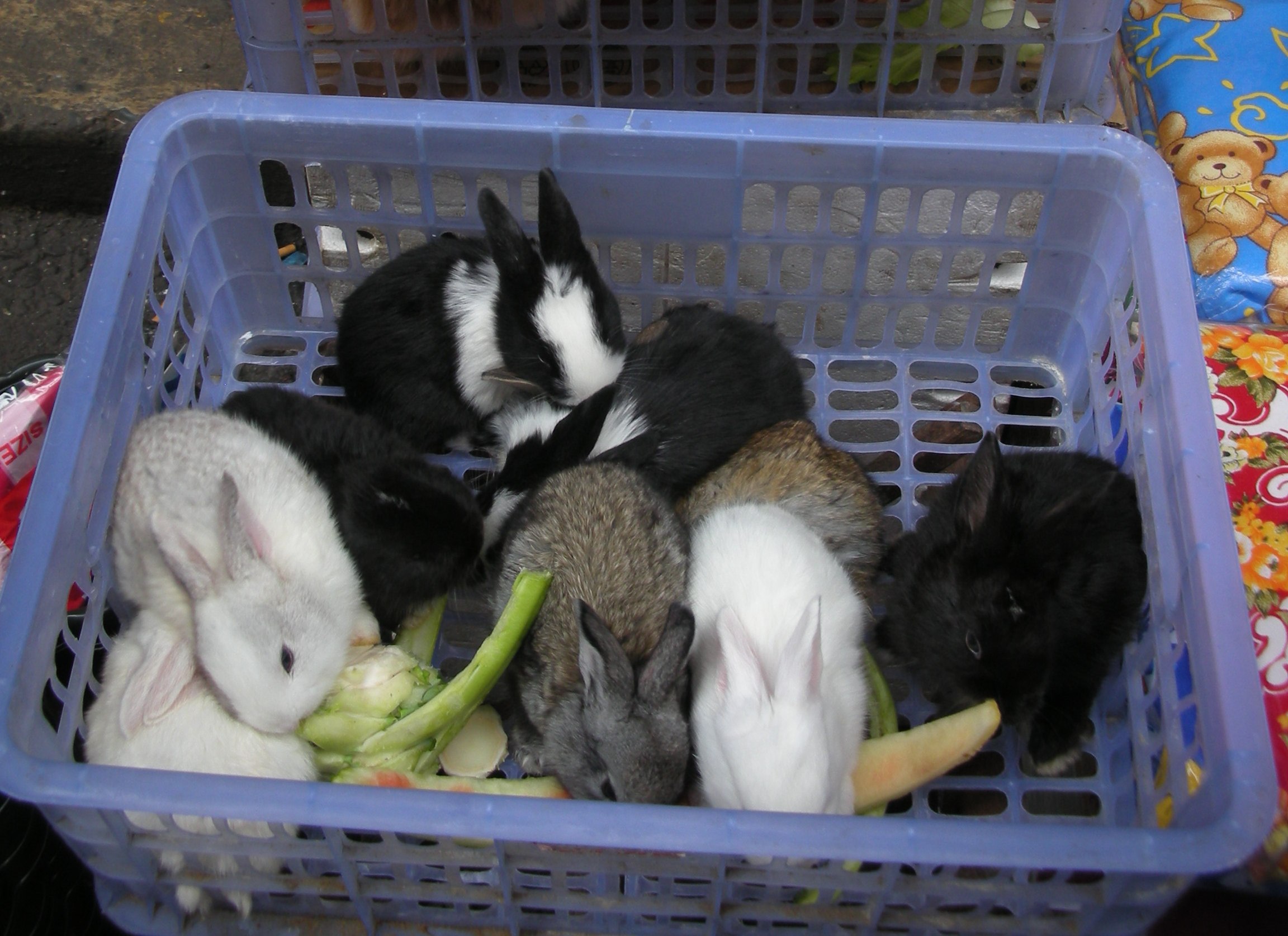
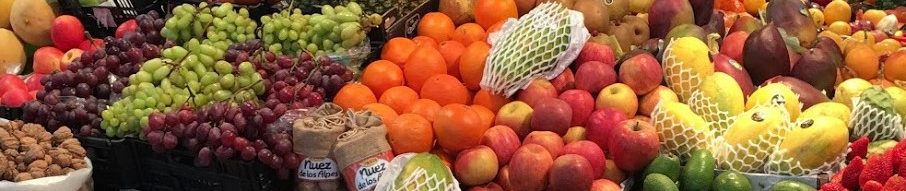
The streets wound on, hemmed with stallholders selling high quality fruit and vegetables, palm-sized baby rabbits (“dinner ma’am?”) sunglasses and t-shirts. Wandering peddlers were offering all sorts of things you could never have imagined needing – and suddenly could not imagine how you have lived without! We all peered, fascinated, at a tiny handheld sewing machine that looked like a staple-unpicker as it stitched a regular seam across a tiny piece of fabric. A ball gown might prove a little ambitious – but it should be OK for hemming hankies…which of course I do a lot!

Deeper into the maze of crowded alleyways, billowing bundles of brightly coloured chiffon had been piled onto the pavement, while a young man enthusiastically snapped a plastic table cloth loudly above our heads, and two men carried a basked of dried fish in a banana leaf basket. Tiny corridors led off these streets and as the crowds thickened and the heat rose, we edged sideways into these cooler spaces past party decorations, fancy dress stalls and reams of string.

Back on the street, men unselfconsciously rolled t-shirts up under their armpits and bared their bellies (what is that about?); an ancient but upright woman stood stock-still in a clearing for several minutes as if in prayer, clutching an armful of fans to her chest; and out of a sidecar, packed to the gunnels with cushions and baskets and boxes peered a small smiling face wedged in beneath all her paraphernalia.

Prices of course, were so far below anything I had seen in Power Plant Mall as to be laughable: a pairs of shorts for PHP 160 (AUS$4.00), a full length bridal gown for PHP 1200 (AUS$30). Perhaps the fabrics weren’t top quality, but the hours of work that had gone into trimming them with bows and frills and sequins were phenomenal. I just wanted to scoop up a handful for my niece’s dressing up box, so she could be a different Disney princess every day of the week. Instead I ended up very sensibly with two umbrellas, a bag of vegetables and some amazing memories.

Posted in Food & Wine, Philippines, Travel | Tagged , , , | Comments Off on Downtown Manila

Pass the Sawsawan Please

Does anyone remember the movie “When Harry Met Sally”? A quirky, 1980s romantic comedy, it was about the antagonism between two people evolving into acceptance, then friendship and ~ finally ~ love.  Now hold onto that thought.

Whenever I think about Filipino food, one scene from that movie keeps playing in my head: Sally & Harry, newly acquainted, are on a road trip across America, and whenever they stop to eat at a roadside cafe, Harry notices that Sally can never order straight from the menu, but always adapts it to suit her own tastes. This infuriates him and he accuses her of being high maintenance, mimicking her order and remarking that “On the side” is a very big thing for you.’

In my world, this is not only high maintenance, it would be considered the height of bad manners to mess the cook about like this. Mothers cry out in horror as their children drown their dinners in tomato sauce (ketchup). Some western diners at high class establishments are even wary of adding salt and pepper in case the chef is insulted by the insinuation that his or her dish is not quite perfect.

In the Philippines, fine-tuning a dish is not only acceptable, it is normal. In the Philippines every diner is expected to give the finishing touches to own his meal with what one food historian refers to as  ‘a galaxy of flavour-adjusters’.

These flavour-adjusters consist of a vast array of dipping sauces and condiments known collectively as sawsawan (pronounced sow-sow-won) that add depth to a dish by providing the accents of sweet and sour, saltiness and spice. The most common and popular accompaniments are patis and bagoong, salty sauces or pastes made from fermented fish and shrimp. You can also try soy sauce, vinegar, pickled green mango, native chillis and kalamansi.

And each diner mixes in his own preferred combination of flavours, enhancing his meal in an action so reflexive that at a recent workshop, most Filipinos were surprised when it was brought to their attention.

This participatory approach to food preparation is an integral part of Filipino dining, the key to Filipino cuisine, without which some dishes might taste a little bland.

On the other hand many of us non-Filipinos have come to expect that a green chicken curry will taste the same in Thailand, Tokyo or Timbuktu. This trend for homogenized dining began in France in the 19th century, when chefs began to write down their recipes for posterity and popular consumption.  Since then, the Thais, the Italians, and the Indians have followed suit. This standardization has become known as McDonaldization and it is a piece of marketing genius – which does not necessarily make it a good thing – but helps it to sell, as most people prefer to know exactly what they are going to get when they order from the menu.

This concept is totally foreign in the Philippines, where innovation is at the heart of Filipino cuisine. Doreen Fernandez, a renowned Filipina food historian claims that it is impossible to standardize the adobo, when every household boasts its own version. One local writer claims Filipino cooks have never been as innovative as they are today. Even as a group of celebrity chefs attempted to fulfill western expectations of standardization in the beautifully presented coffee table cook book Kulinarya, local restaurants continue to explore, creating imaginative blends of past and present, east and west. It’s what they do. It’s who they are.

Filipino cuisine is like halo halo: a mix of tastes, textures, cultures and colours. Or as local writer Molina A. Mercado put it so clearly:

Filipino food was prepared by Malay settlers, spiced by Chinese traders, stewed in 300 years of Spanish rule and hamburgered by American influence

Some call it the original fusion cuisine, but it is not the ingredients from different countries that are blended, as much as the entire menu: where sinigang, Hokkien noodles and paella may all sit together at the same table. And for 90 million Filipinos it is the best cuisine in the world.

Yet I have heard many Filipinos complain that foreigners don’t take Filipino cuisine seriously. They just don’t seem to get it. Many have had the cheek to insinuate that Filipino Cuisine is an oxymoron.  It seems to be one of the most misunderstood cuisines in the world

Personally I have had mixed experiences. Our first exploratory dining experience in Manila was a culinary disaster of fatty beef and tepid noodles. Since then, I have persevered, and I have discovered some dishes I thoroughly enjoyed, although there are still many I find challenging. However, I hope that is about to change.

At a recent food writing course, one exercise referred to renowned food critic Jeremy Steingarten, a fussy, faddish lawyer, with more food phobias than I’ve had hot dinners. The list of things he would never eat even if he was starving to death on a tropical island was longer than the list of things he actually liked. Realizing that he could hardly fulfill his new role as food critic for Vogue magazine with so many food ‘allergies’ he goes on a mission to overcome his finicky taste buds.

It’s a known fact – a standard Year 10 science experiment – that we can actually retrain our taste buds. No food phobia is innate. Force yourself to eat something you hate 8 times, and you’ll suddenly find you are enjoying it. As mothers, we’ve all done it to our kids: make them eat their broccoli and – short of power play – they will eventually like it.  I’ve even persuaded my husband to eat olives.

Now, in conclusion, I would like to take you back to that thought you were holding… remember? Like Harry & Sally, it is possible to adjust your taste buds and your expectations and learn to love something you thought you loathed. So, as Mr Steingarten suggested, I am on a mission to learn to appreciate the unfamiliar tastes and textures of sisig and sinigang, and to educate myself on how to apply the sasawan… I may have to draw the line at balut – “Avian infanticide” is just one step too far – But I already drink my kalamansi juice with-syrup-on-the-side!

Posted in Food & Wine, Local Culture, Philippines | Tagged , , , , , , , , , , | Comments Off on Pass the Sawsawan Please

Tea with a Twist


The first bowl washed the cobwebs from my mind –

the whole world seemed to sparkle

A second cleansed my spirit like purifying showers of rain

A third and I was one with the immortals.

Chao Jen, The Way of Tea, Tang Dynasty


It is my daughter’s eighteenth birthday and I wanted to take her somewhere special – a mother and daughter outing – to celebrate..

Now I have long had a penchant for a good old British afternoon tea, so when I discovered that the Manila Peninsula serves afternoon tea in the Lobby every afternoon, the decision was made.

Traditionally, afternoon tea was taken by the upper classes, a symbol of their wealth and position, when tea was highly taxed and highly fashionable. There are rumours that afternoon tea originated in France in the seventeenth century, tea having arrived in Paris almost twenty five years before it reached English shores. The Brits, however, claim it was their invention.

In 1717 Thomas Twining opened his first teashop for ladies in London. By the middle of the nineteenth century the Duchess of Bedford, who found the growing gap between luncheon and dinner quite enervating, had begun to make a social event out of a late afternoon snack. Consisting of bread and butter, small cakes and of course a pot of tea, it was served in the late afternoon (between four and five o’clock) and became very popular with the aristocracy. Eventually the habit drifted down to lesser mortals.

To me, afternoon tea whispers of a Georgian sitting room opening out onto an expansive English lawn; the scent of roses drifting through the windows; the gentle hum of bees; silver teapots, scones and cream and cucumber sandwiches. Or perhaps something ritzier at the Ritz or the Savoy with triple-decker cake plates, bone china and an optional glass of champagne.

I was hardly expecting to find the former in downtown Makati, but I hoped the latter might be a distinct possibility. We had not been to the Peninsula before. We were delighted with its understated elegance. Waiters drifted about in tailored Thai silk uniforms of chocolate brown. The tables were set with Minton Haddon Hall china and plain silver cutlery. The chairs were deep and decadent. Up on the balcony a flute and guitar duetted amiably.

Explanations – and drinks – were a little slow in arriving, but it eventually transpired that afternoon tea could be selected from the buffet whenever we were ready, and tea and coffee would arrive “in a while ma’am”. We also selected a lovely bottle of bubbles in honour of the occasion.

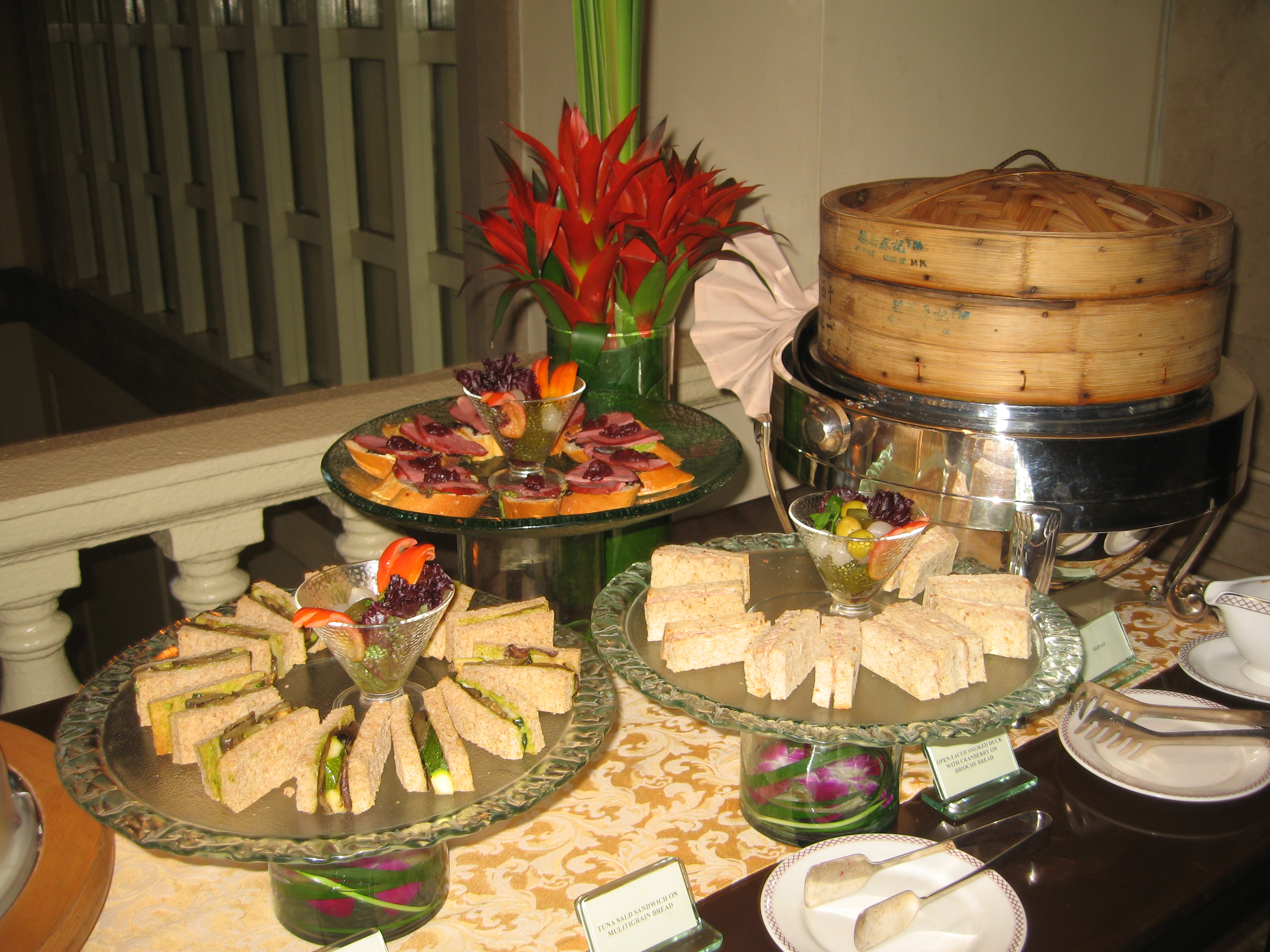
Wandering over to the buffet we discovered two tables laden with a profusion of dishes. The savoury table, while there was no sign of cucumber sandwiches, or even egg-and-cress, displayed baby quiches, crab cakes and bite-sized cannelloni, crab salad on slices of baguette, roast chicken sandwich fingers and tiny poppy seed rolls filled with roast duck.  A cheese platter and a fruit platter completed the display. None of these dishes were exactly traditional tea-time fare, but all fitted the bill of dainty finger food – except perhaps the huge dish of fettucine carbonara.

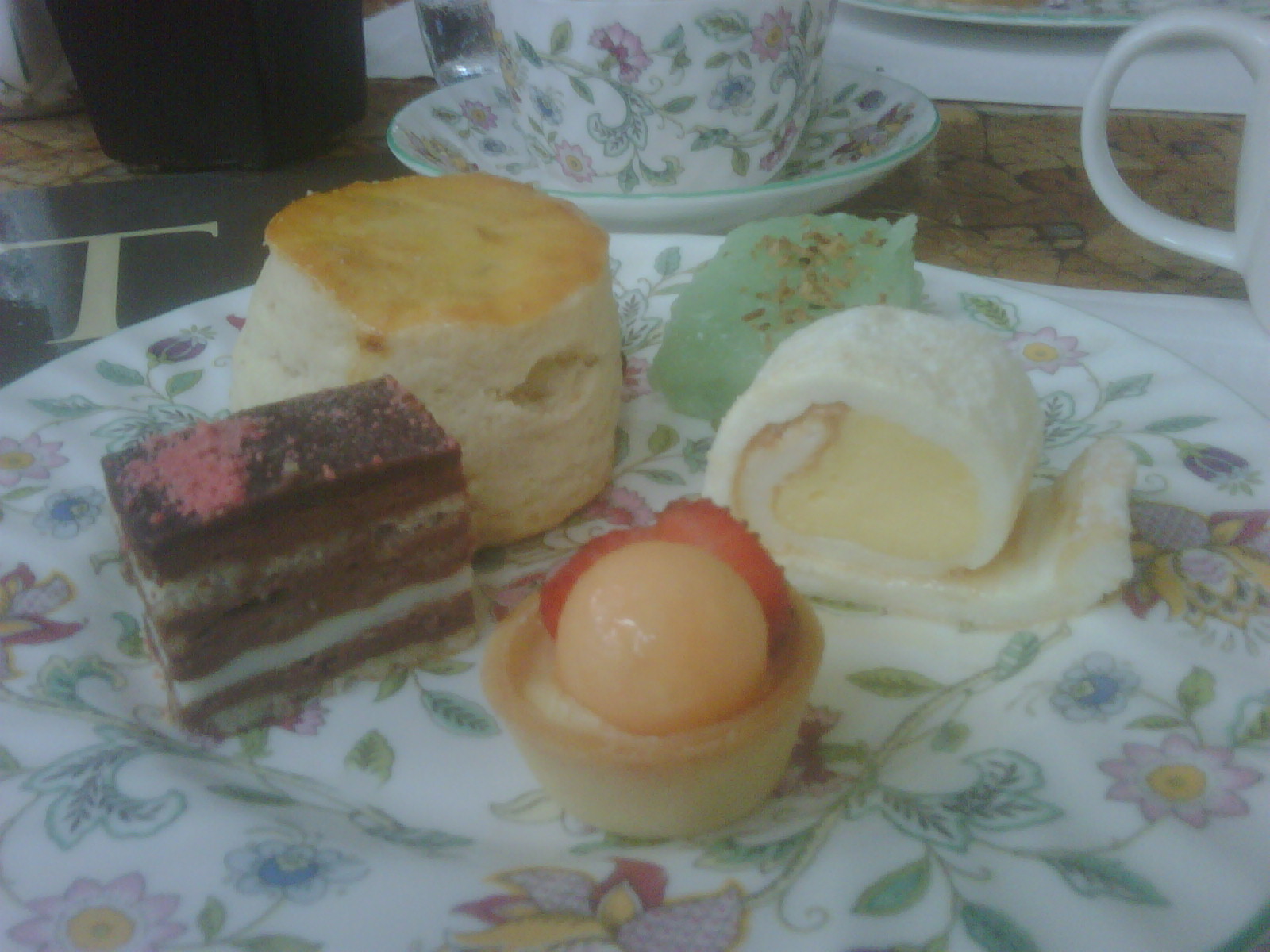
The sweet buffet was highly Filipino-flavoured. Apart from the ubiquitous scones which were served with lemon curd, whipped cream and a delicious strawberry jam, there was a rich chocolate pudding covered in flaked almonds, surrounded by a myriad Filipino-style cakes and slices: bikon pandan (think green gelatinous rice, like cold rice pudding squares, but surprisingly morish); cassava cake reminiscent of small slices of pumpkin pie; brazzo de Mercedes, which my friend Monique tells me is also called merengue and resembles the French dish ile flottant – an uncooked meringue roll filled with thick custard and definitely my new favourite.

Offerings can vary from day to day, but the tea stays much the same. At the Peninsula, they serve a variety of teas from chamomile and peppermint to Earl Grey & a range of special Peninsula blends. My favourite is the cinnamon tea. And if you are making a real occasion of it, let me recommend the Bridgewater Mill Sparkling Chardonnay – very tasty and decidedly cheaper than its French cousins!

All in all we had a lazy, luxurious afternoon. In the course of two hours, the tea pot was filled and re-filled , as were our plates. And it was a very peaceful and reasonably priced treat as a little time out for yourself or as somewhere special to take guests.

Posted in Food & Wine, Philippines | Tagged , , , , | Comments Off on Tea with a Twist

Travels with My Daughter

‘Gorgonians, black coral, shells, turtles, rays, grunts, jacks, snappers, and… soft corals.’ Luscious names that rolled off the tongue and tempted us to dessert the shopping malls of Metro Manila, rest our blistered feet and explore further afield. My husband suggested Eagle Point, a remote, unassuming resort near Anilao, Batangas.

It was mid-November. My daughter, her best friend and I had left Sydney with post HSC burn out, to join the rest of the family in Manila. The city was great fun, but not the R&R we really needed. Anilao sounded like a perfect retreat. We set out two days later armed with books, bathers, snorkel, goggles and my computer, as I would need to write smug emails to all my friends about life on a tropical island and cocktails by the pool.

On this, our first foray out of Metro Manila, our eyes were glued to the windscreen for the entire trip. Shop houses, rice farms, goats and caribou, provided a very different vision of the Philippines to the one from our 32nd floor apartment.  We loved the brightly decorated jeepneys and marvelled at how many people could squeeze into the low slung side cars of the motorcycle taxis.

Anilao is a brightly painted town hanging off the edge of a narrow, lush peninsula in southern Batangas. It is also a popular and accessible diving area, less than three hours drive south-west of Manila. A shuttle service can ferry tourists to and from Manila airport, but for locals it’s an easy drive, with parking on the road above the hotel and a hair-raising jeepney ride down the cliff.

It is a good idea to buy a package that includes all meals as access to other restaurants is limited. Luckily, the hotel menu proved to be surprisingly varied – for a short-term visit at least – and the bar was well stocked.

Eagle Point is not a high end resort, despite its claim to five stardom – if you are looking for luxury accommodation and kids clubs you may need to look further afield – but there is a water-slide, two split-level pools and a salt-water diving tank filled with grouper, baby sharks and a shy turtle that hides amongst the rocks.  We never found the games room, but apparently it has a dart board, table tennis and billiards; there’s an in-house masseuse and a tiny gift shop. A number of old aviaries houses some rather large birds including a horn bill and an eagle which may interest the kids.

We had been warned not to expect too much, so the rooms exceeded our expectations: simple, attractive and clean. Just make sure you are housed in the new part of the hotel and not in one of the old chalets. These were dark and run down and received a scathing review from one unhappy blogger!

While the girls relaxed by the pool, I set up house in the open air dining room with its panoramic views across the bay. (Well, I had all those emails to send!) With window boxes brimming with pink bougainvillea, a sea breeze drifting through wide open shutters and waves lapping gently below, I was in heaven. I discovered freshly squeezed kalamansi juice, ‘syrup-on-the-side, and the staff cheerfully armed me with a bottomless coffee pot. I typed happily for hours, distracted only by a rowdy gecko drunkenly chirping above the bar.

The beaches are not really beaches as we Aussies know them, unless you are familiar with England’s Brighton beach. Unlike Brighton, this rocky coastline is barely tidal, so the waves lap against the rocks mere metres from our balcony.  Hiding beneath the waves, right in front of the hotel, is a stretch of protected reef.

According to the website, the house reef was discovered several years ago by a British team of marine biologists. It is made up of ‘287 species of corals compared to only 50 species in the Caribbean and 250 species in our world-famous Tubbataha Reef in the Sulu Sea.’  So the area is popular, not only with amateur snorkelers like me, but also with trained divers.

Snorkeling and scuba diving are Eagle Point’s main attractions. A dive shop concession stocks all the necessary equipment and internationally accredited diving courses are offered by qualified instructors. It is possible to dive here all year round, though, between July and September typhoons can cause choppy waves and poor visibility.

I have to admit I am not the bravest of swimmers, and was unenthusiastic about diving, but Eagle Point is an easy, unthreatening place to start: visibility is good, the sea is warm and there is a lot to see – although I was convinced that the rubbery-looking electric blue starfish had been strategically placed on the reef for our entertainment.

Having gained a little confidence close to home, we spent Day Two sailing out past Sombrero Island to Sepoc Point. Sombrero Island provides excellent diving, but you need to beware of strong currents. Unfortunately, the coral reef off the beach at Sepoc Point looked like a graveyard. Apparently a lot of the local reef has been badly damaged by explosives used for fishing and, sadly, old rubbish is all too visible. Nonetheless, the prolific reef fish (or ‘Nemo’ fish, as my daughter called them) kept us engaged for hours.

Our guides then cooked us a wonderful seafood barbecue on the beach, and as always it tasted better for the fresh air. Afterwards, we decided what we most craved now was ice cream. We headed back, happy and sun burnt, to the hotel fridge full of Haagen-Dazs.

Posted in Philippines, Travel | Tagged , , , , , , , | Comments Off on Travels with My Daughter

Signposts

Hi! I am a travelling spouse!

I recently discovered this label in Manila and it mostly fits perfectly. On a bad day, though, it can make me feel horribly dependent and I begin to wonder who I am when I am not labeled ‘wife’ or ‘mother’. Five years ago I was yet again faced with that interminable, unavoidable travelling spouse dilemma. ‘What now?’

The yellow brick road had directed us back to Oz after 15 years away. We had chosen schools for the children and a house. We had unpacked a 40’ container, set up bank accounts, internet connections and our filing cabinet. My husband had started work. The kids were all at school. I finally had time on my hands, and it was time to get a job. But after years of traipsing the world through many countries that didn’t want foreign women in their work force, my examples of paid employment seemed horribly thin on the ground. As I tried to write an impressive and solid CV, none of it seemed to add up to much. My confidence was rapidly wilting. I crawled under the quilt and disappeared from sight for 2 days, drank endless mugs of tea and bemoaned my fate as an unemployable housewife.

Then, out of the blue, an old friend rang to see how I was getting on.

‘What am I going to do?’ I wailed from the depths of the duvet.

“Have you thought of studying’ she asked me.

‘Yeeeees, but what?’ I whined, querulously.

The answer made me clamber out from under the quilt with ears on stalks. A Masters degree in Gastronomy! Really?  Where could I sign up?

Now before you jump to conclusions, I will pre-empt a few common misconceptions. Firstly, I was not about to grab a telescope and become a stars-gazer. Nor was I a doctor wanting to specialize in stomach surgery. And I was certainly not aiming to become the next Nigella Lawson. I like eating, not cooking!

Gastronomy is an academic course that studies the business of food. My old alma mater provided a three year on-line course  that opened wide the gateway on the-world-according-to-foodies and showed me how Australian food culture had evolved in the two decades we had been away. We studied food history and the rise of TV cooking shows, we examined myriad international food writers, both fiction and non-fiction, and debated topical food related issues such as the effects of globalization on regional food growers. In the process,  it somehow validated a lifetime of disparate experiences and an eclectic employment history.It also, and most joyously, provided the perfect excuse for eating out a lot!  And it might just give me an entré into journalism, something I had always hankered after.

With students from  all over the world, coordinating different time zones for on-line tutorials was often problematic. But when it did work , it connected me to a lot of new cyberspace mates with a common interest in all things food-related.  The first two years were brilliant: academically challenging, intellectually stimulating and enormously confidence building.

The final year proved the highest hurdle to overcome: deciding on a topic, constructing a thesis, months of research, months of writing. My husband and children were endlessly patient with my regular breakdowns over deadlines, lack of direction and misdirections. I am pleased to say that I made it through, and my graduation was one of the proudest moments in my life. And just after graduation we moved to Manila.

So that signpost I came across while hibernating under my quilt may not have glittered like a disco ball, but it led to opportunities I could never have imagined! I have met so many fascinating people and learned so many amazing new things over the past 5 years. I have enjoyed numerous food and wine festivals, attended three Australian Gastronomic Symposiums and even  presented papers. The most recent conference was in Canberra earlier this year. The organizers asked for papers on, amongst other things, the effects of colonization on aboriginal foodways.  I spun this round to look at the effects of colonization on Filipino foodways.  Six months of research on Filipino food history gave me a fascinating insight into the culture, history and eating habits of my new host country. It even stirred up some interest from local food writers!

So I not only rediscovered my confidence, I located my pen and now I can’t put it down, having thought that part of me had long since been submerged and most probably drowned in the distractions of motherhood. I can’t promise you it’s any good, but it’s liberating, and I am loving it.

Sometimes life seems to get tangled up; plans go awry, and you feel like you’ve lost the plot. And then you find the page again and there is a wonderful clarity. All that has gone before makes retrospective sense –it validates that ticket you bought way back at the end of High School. It may not have been for the route you were planning to take at 18, but life is like that. Plan too heavily and it’s bound to go pear-shaped. But at half past 44, I have found a certain peace accepting where life has brought me. It has made me who I am and led me here. And it will presumably point the way to the next big adventure… because life is the journey, not the destination. Cheers!

Posted in Biography | Tagged , , , | 1 Comment